Kids education
The best online English classes for kids in India match different goals. British Council covers speaking, reading, and writing in live groups. Novakid uses short private lessons for younger children.

Preply lets parents choose a tutor with child teaching experience. WizMantra offers short weekday lessons; Tiny Steps checks skills first.
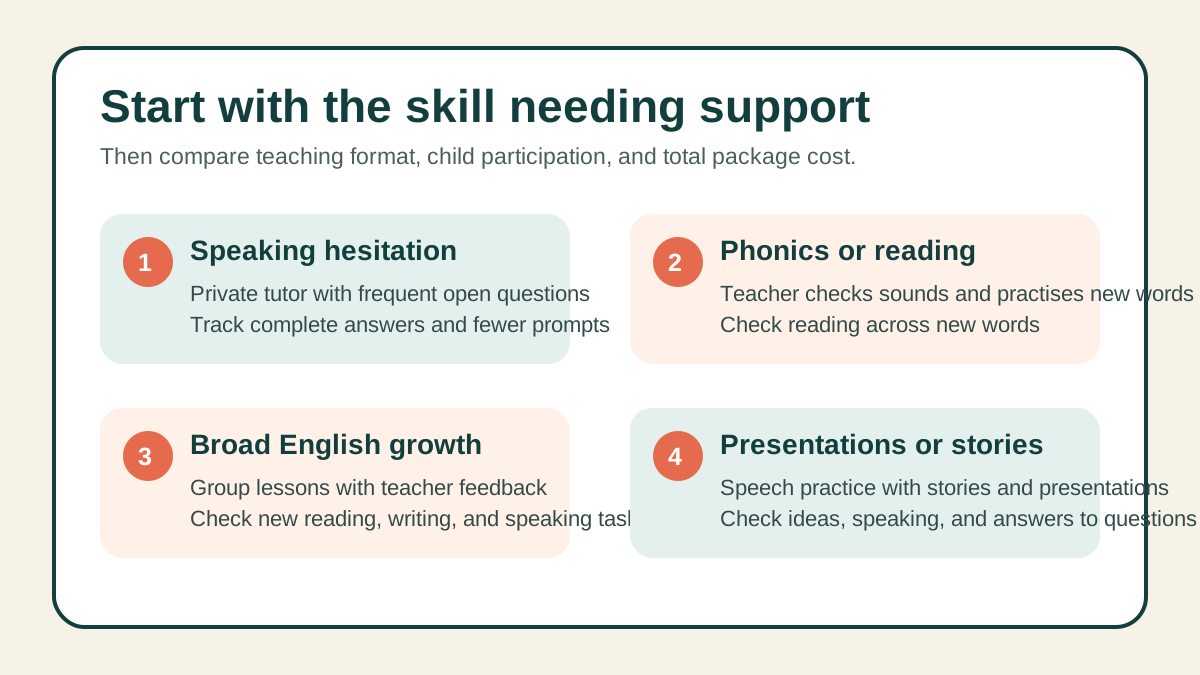
Online English speaking classes for kids differ in format and purpose. Start with the skill causing trouble: speaking, reading, writing, or presentations. A child who reads well but hesitates needs speaking practice.
Prices and course details reflect checks on September 21, 2026. Sales and package options can change after that date. Confirm the final amount and cancellation rules before paying.
In This Article
- Quick comparison of nine live online English classes
- Why these nine classes made the comparison
- Choose the first English skill needing help
- When a shy child hesitates to speak
- Phonics, reading, and understanding stories
- Grammar, writing, or sentence formation
- Public speaking and presentation skills
- Nine useful online English classes for children
- 1. British Council: broad group courses
- 2. Novakid: short private lessons for younger children
- 3. Preply: parent-chosen tutors
- 4. Cambly Kids: conversation across English accents
- 5. PlanetSpark: speeches and presentations
- 6. Vedantu: English courses tied to Indian grades
- 7. Bambinos.live: speaking, reading, and writing together
- 8. WizMantra: frequent private speaking practice
- 9. Tiny Steps: skill checks and public prices
- What are the fees for online English classes for kids?
- One-to-one English lessons or group classes?
- How to compare English trial classes across three lessons
- What should parents watch during trial lessons?
- What makes an online English lesson worth paying for?
- What one Novakid parent reported
- Check safety and payment rules before buying
- Common parent questions
- What if my child barely speaks during a trial?
- Is a native English speaker always better?
- How many weekly classes should a child take?
- Can an English app replace live classes?
- How soon should parents expect progress?
- What age can children start online English classes?
- How can parents support practice between classes?
- Make the final choice
- Sources
Quick comparison of nine live online English classes
Compare ages, lesson lengths, trial options, and published prices below. Each class covers different skills and uses a different teaching format.
| Provider | Strongest match | Ages or grades | Live format | Teacher-led time | Trial and listed price |
|---|---|---|---|---|---|
| British Council | Speaking, reading, and writing | Ages 5–17; course varies | Online groups | Depends on course | Consultation; Primary English costs ₹29,500 for 34 hours |
| Novakid | Playful private tuition | Ages 4+ | Private video | 25 minutes | Free trial; from $95 monthly on global site |
| Preply | Personal tutor selection | Child specialists available | Private video | 25 or 50 minutes | Charged trial; from $3 hourly |
| Cambly Kids | Native-speaker conversation | Ages 4–15 | Private video | Depends on plan | Trial offered; account pricing |
| PlanetSpark | Speaking and presentations | Ages 4–14 | Private video | Depends on package | Free demo; quote required |
| Vedantu | Indian grade structure | Grades 1–6 | Groups or private | 30–60 minutes | ₹12,499 for 32 group classes; 2025–26 listing |
| Bambinos.live | Speaking, reading, and writing | Ages 4–15 | Private or groups | 50 minutes | Free demo; quote required |
| WizMantra | Frequent speaking practice | Ages 6–14 | Private video | 30 minutes | ₹299 demo; ₹4,890 monthly |
| Tiny Steps | Skill check before classes | Ages 3–12 | Private or small groups | 35–60 minutes | Free skill check; from ₹180 group |
Listed prices come from provider sites checked during September 2026. Taxes, sales, and package choices can change your final amount. Ask quote-only providers for the full price in writing.
Why these nine classes made the comparison
Among sixteen options, these nine offer live teaching to Indian children. They cover private tutors, groups, and courses with several skills. Apps without teachers answer a different parent need. We compared ages, class sizes, lesson lengths, and package prices.
We attended no lessons during the comparison. Use trial lessons to judge each teacher yourself.
Choose the first English skill needing help
One provider cannot serve every child equally well. A child might speak freely but struggle with reading. Name the first weak skill before choosing any provider.
When a shy child hesitates to speak
Some children know many words but answer with one word. Open questions and longer pauses invite fuller answers. Private lessons can offer more speaking time during each class.
A quiet child may speak very little inside larger groups. Ask how every child gets enough speaking time.
Phonics, reading, and understanding stories
Phonics teaches children how letters match sounds in spoken words. Speaking practice alone cannot build missing reading skills. Ask teachers to check sounds, reading accuracy, and story meaning. A child reading cat but struggling with ship may need sound practice.
Finished worksheets may only show memory of familiar work. Ask for new words and unseen stories during progress checks. Fresh work reveals skills beyond memorised worksheets.
Grammar, writing, or sentence formation
Some children speak freely but write short or mixed-up sentences. A course covering several skills can connect grammar with speech and writing.
Ask how teachers teach grammar beyond blank-filling exercises. Strong lessons use grammar inside stories, answers, and personal writing. Progress should appear during new tasks beyond practised examples.
Public speaking and presentation skills
Public speaking classes for kids cover speeches, stories, debates, and presentations. They may spend less time teaching daily conversation or reading.
Choose speech coaching when presentations form the main goal. A hesitant beginner may need sentence building first. A fluent older child may benefit from debates. Ask for one recorded speech to compare future progress.
Nine useful online English classes for children
1. British Council: broad group courses

British Council teaches children from age five through seventeen online. Primary English serves ages six through ten. Secondary English serves ages eleven through seventeen. Live groups use projects, pair work, and home tasks.
Primary English costs ₹29,500 for 34 teaching hours. Longer terms cost ₹59,000 for 68 hours or ₹88,499 for 102 hours. Each term works out near ₹868 per teaching hour.
Choose British Council for speaking, reading, and writing alongside classmates. Ask about group size, placement, and missed-class rules before enrolling.
2. Novakid: short private lessons for younger children

Novakid teaches children from age four in private 25-minute lessons. Games before and after bring total session time near 40 minutes. Children receive homework, games, and parent progress reports. The free trial requires no payment card. Short teacher calls may suit children who tire during long video lessons.
Standard and Premium teachers follow the same course plan. Premium teachers speak English as their first tongue. Novakid advertises monthly plans from $95 on its global site. Indian checkout totals may differ from that price.
English-only lessons may challenge children needing Hindi support. Ask if one teacher can teach every weekly lesson.
3. Preply: parent-chosen tutors

Preply lets parents choose among online English tutors for kids. Filter for child teaching experience, class times, and specific skills. Tutor videos let parents hear each teacher before booking.
Hourly prices start at $3, though each tutor charges differently. Parents pay for trial lessons lasting 25 or 50 minutes. A strong profile cannot prove how one teacher works with your child.
Before booking, ask how the tutor checks progress and shares feedback. Preply suits families willing to compare individual teachers closely.
4. Cambly Kids: conversation across English accents

Cambly Kids offers private video lessons for ages four through fifteen. Tutors speak English as their first tongue. Children hear different accents while practising everyday conversation. Levels span A1 through C1 on the CEFR scale.
A1 covers beginner English; C1 covers advanced English. Use the trial assessment to choose a level beyond age. Repeated tutor changes can waste class time on introductions.
Parents in India need an account to see plan prices. Check the trial offer, subscription length, and renewal amount there.
5. PlanetSpark: speeches and presentations

PlanetSpark teaches ages four through fourteen in private live classes. Children practise storytelling, role-play, pronunciation, and prepared speeches. The free demo shows how the teacher leads a class.
Parents can review recordings and progress reports after classes. AI practice appears between teacher sessions, but teaching time remains live. Ask for the total price, class count, and refund terms. Choose PlanetSpark when stories and speeches both need attention.
6. Vedantu: English courses tied to Indian grades

Vedantu offers spoken English classes for kids in Grades 1 through 6. One four-month plan contains 32 one-hour group lessons. Its advertised ₹12,499 fee carries a 2025–26 label. Younger children can also take private phonics classes.
Another Grades 3–5 package combines 60 private lessons with six group classes. The ₹24,000 total covers 20 weeks of lessons.
Vedantu works for families following an Indian school-grade course. Vedantu shows a price-per-class figure that conflicts with its package total. Check the final amount, start date, and group size before paying.
7. Bambinos.live: speaking, reading, and writing together

Bambinos Unbox English serves children aged four through fifteen. Each live video class lasts 50 minutes. Children practise speaking, reading, writing, grammar, and presentations. Families can choose private lessons or groups reaching six children. Packages contain 32 or 64 classes, with a free demo first.
A child seeking conversation alone may spend time on other skills. Ask if your younger child can manage the full lesson. Get the package price and refund terms in writing.
8. WizMantra: frequent private speaking practice

WizMantra teaches ages six through fourteen in private video classes. Each live weekday lesson lasts 30 minutes. One trainer teaches the full course under the advertised plan.
Monthly tuition costs ₹4,890; two months cost ₹9,780. The three-month option costs ₹14,670, and the demo costs ₹299. Five weekly lessons need room around homework and travel. Choose WizMantra when short, frequent speaking practice suits your child.
Use the paid demo to count full spoken answers. Ask who replaces the trainer during any absence.
9. Tiny Steps: skill checks and public prices

Tiny Steps teaches ages three through twelve across several English skills. A free 35-minute private check comes before choosing classes. Parents can focus on phonics, reading, grammar, writing, or speaking.
Private classes cost ₹400 for 35 minutes each. Packages cost ₹4,800, ₹6,400, or ₹9,600 for 12, 16, or 24 classes. Small groups cost ₹180 through ₹300 per child per class. Group lessons last 40 to 60 minutes, depending on size.
The lowest group price needs six children at one suitable time. Confirm teacher availability before comparing that price with private lessons. Ask about teacher changes and access to saved recordings.
What are the fees for online English classes for kids?
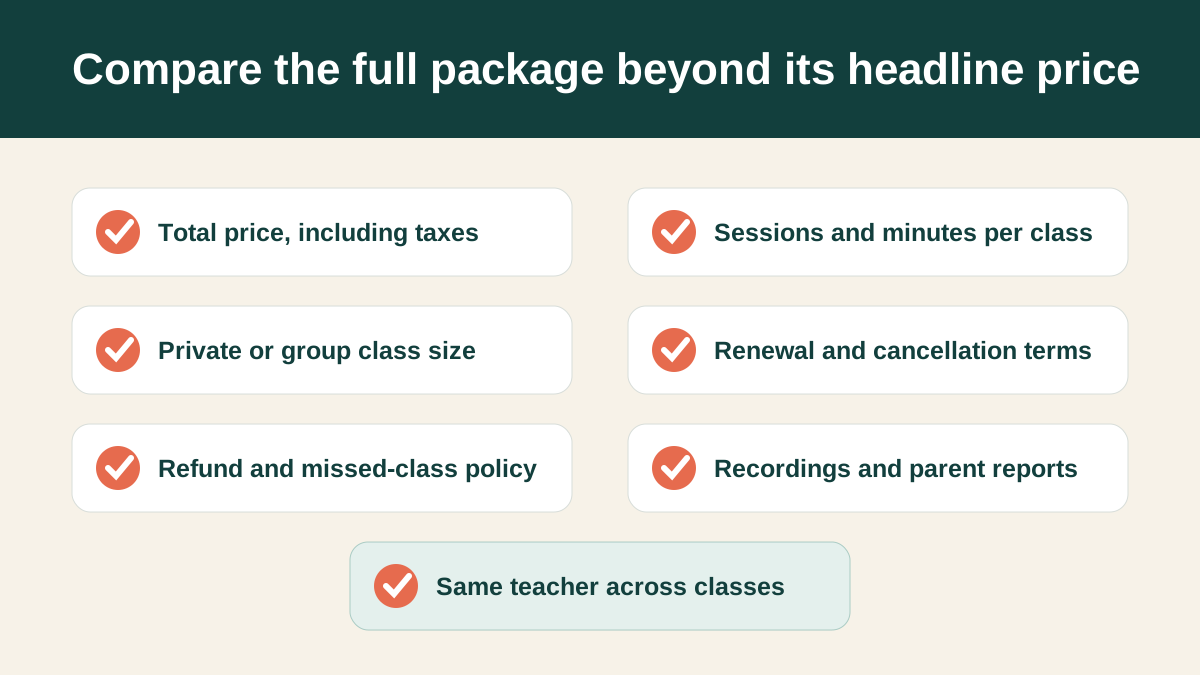
Published group prices start at ₹180 per child with Tiny Steps. British Council charges ₹29,500 for a 34-hour group term. Compare teaching minutes, children per teacher, and package totals. An hour of teaching buys different amounts of child speaking time.
Monthly plans, tutor rates, and group packages use different billing rules. The table converts short lessons into comparable 60-minute amounts. Providers still charge their original prices at checkout.
| Provider and format | Published price | 60-minute comparison | Important condition |
|---|---|---|---|
| British Council group | ₹29,500 across 34 hours | About ₹868 hourly | Group course and term package |
| Vedantu group | ₹12,499 across 32 one-hour classes | About ₹391 each class | 2025–26 fee; confirm current price |
| Tiny Steps private | ₹400 across 35 minutes | About ₹686 per 60-minute equivalent | Each paid lesson lasts 35 minutes |
| Tiny Steps group of six | ₹180 per child per 60-minute class | ₹180 each class | Matching group and time required |
| Preply private | From $3 hourly | Hourly rate | Tutor experience varies |
| WizMantra private | ₹4,890 monthly, five weekdays weekly | Class count changes each month | Frequent attendance required |
For equal time, Tiny Steps private classes cost about ₹686 hourly. Families still pay ₹400 for each 35-minute lesson.
An hourly number cannot reveal teacher skill or child speaking time. Compare both during the trial before choosing a cheaper package.
One-to-one English lessons or group classes?
Private lessons pair one child with one teacher. After hesitation, the teacher can switch questions or slow the lesson. Children struggling with sentence building may need uninterrupted correction.
Groups bring classmates into the conversation and create an audience. Peers can question a speech, offer replies, and practise listening. A large class can still leave a quiet child watching. Check the largest group size before committing to a package.
Private lessons suit children needing frequent correction at their own pace. Small groups suit speeches and conversations with other children.
How to compare English trial classes across three lessons
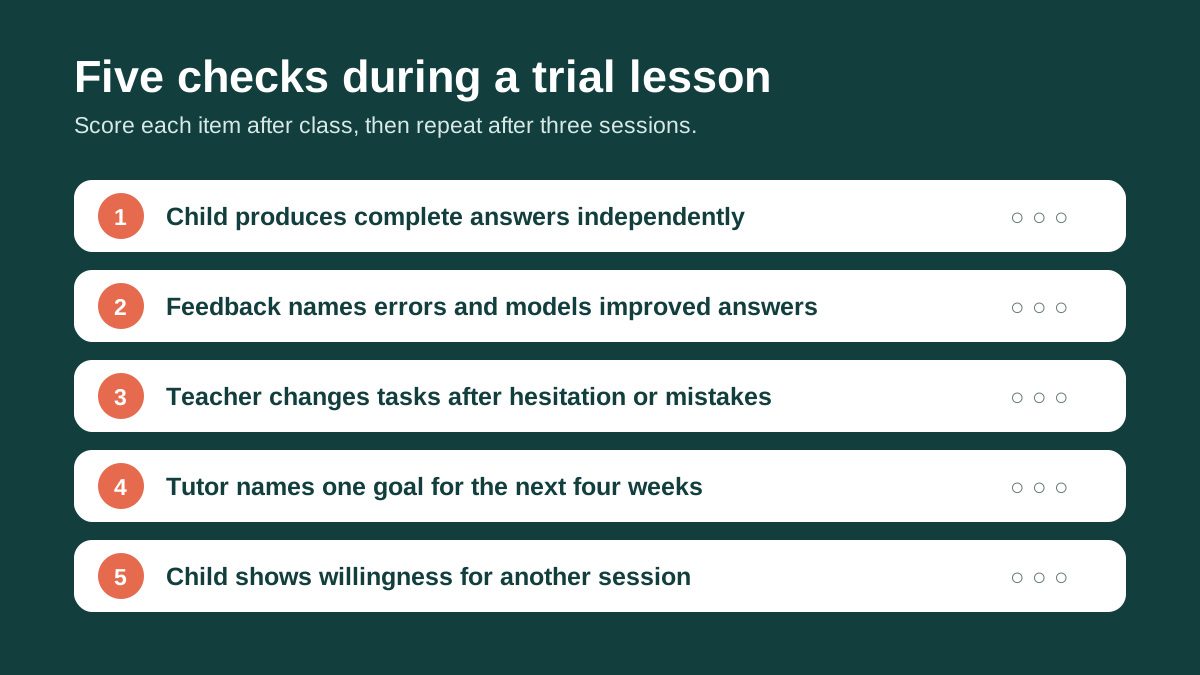
One friendly demo can show comfort between teacher and child. Three lessons reveal how teachers respond to repeated mistakes. Use the same five checks after every class.
What should parents watch during trial lessons?
-
Count child speech. Count full answers, child questions, and unplanned comments during a typical class. Many one-word answers may show weak questions or rushed teaching.
-
Check teacher corrections. Useful corrections name the mistake, model a better answer, and invite another try. Praise alone cannot teach the child what needs changing.
-
Watch lesson changes. Strong teachers slow down, switch examples, or pause after repeated mistakes. Repeating one question after blank answers may waste class time.
-
Ask for one four-week goal. The teacher should name one skill and one way to practise it. Check that skill again using a new task.
-
Ask about the lesson afterward. Ask which task was hard and which held attention. One difficult lesson proves little, but repeated dislike needs discussion.
After lesson three, ask one fresh speaking or reading question. Compare the answer with an early lesson answer. Look for longer replies, fewer prompts, or self-correction. Badges and finished worksheets reveal less about independent skill.
What makes an online English lesson worth paying for?
Online English speaking practice needs time for full answers. Children also need fresh tasks, helpful feedback, and chances to respond. Independent studies support several teaching habits parents can spot during class.
After a teacher asks a question, the child needs thinking time. A 2021 study of 80 Grade 6 lessons linked longer pauses with fuller answers. Wait through a few quiet seconds before accepting one-word replies.
Fresh speaking tasks reveal more than repeated worksheets. A 2017 study found children scored higher after recorded speaking tasks than paper homework. Children need chances to use new words beyond repeated drills.
Peers should answer, question, and build on one another. A 2022 review found partner skills shaped preschool English talk. Each child also needs chances to join that talk. An engaged child can still spend most minutes listening.
Writing also needs feedback on new work. A 2024 review found promising results from shared online tasks and teacher feedback. Those studies covered mixed ages and countries.
No cited study directly compares these nine providers in India. Use the teaching habits as checks, never as performance guarantees.
What one Novakid parent reported
One parent praised Novakid while reporting missing lesson recordings. Trustpilot marked the August 2026 review from Jonathan as Verified. He liked the platform but struggled to replay earlier classes.
Try opening a saved recording inside the parent account. Ask what happens if an earlier lesson video disappears. The Verified badge concerns the review; it cannot measure child progress.
Novakid has claimed its Trustpilot profile and pays for extra tools. One parent account cannot represent every family experience.
Check safety and payment rules before buying
Before buying, check how teachers contact children outside class. Ask who receives complaints about unwanted teacher messages. Confirm parent controls before your child enters a class. Check who may watch, download, or delete saved recordings.
Get the full fee and renewal date in writing. Ask about refunds after missed classes, cancellations, or teacher changes. Save the current terms beside your receipt before lessons begin.
Common parent questions
What if my child barely speaks during a trial?
Ask the teacher to use pictures or a familiar topic. Watch how long your child gets before another question. One silent lesson can reflect nerves; try another teacher too.
Is a native English speaker always better?
Teacher skill and useful corrections matter more than birthplace. Some Indian teachers connect school work; other tutors bring different accents.
How many weekly classes should a child take?
Begin with two weekly lessons if school fills most evenings. A five-day plan needs the same open time each weekday. Compare missed-class rules before choosing frequent lessons.
Can an English app replace live classes?
Software supports vocabulary practice; human teachers respond during live conversations. A 2026 review found smoother speech in some chatbot studies. Several tools still struggled with longer conversations. Apps offer extra practice between lessons with a teacher.
How soon should parents expect progress?
Record a short answer before classes begin. After four weeks, compare fuller answers across fresh topics.
What age can children start online English classes?
Tiny Steps accepts children from age three; Novakid starts at four. For preschoolers, watch attention and comfort during the first lesson. A child refusing the screen may need a later start.
How can parents support practice between classes?
During dinner, ask one open question about a picture or school story. Wait for a full answer before correcting one mistake.
Make the final choice
Select the teacher whose lessons match the main skill need. Check that your child speaks, responds to feedback, and joins willingly.
Choose only after viewing the written package total and cancellation rules. Try a second teacher when the first trial leaves doubts.
Sources
- British Council courses for children
- British Council primary programme fees
- British Council secondary programme
- Novakid plans and trial
- Novakid teacher time and activity time
- Preply child tutor marketplace
- Preply trial policy
- Preply homepage
- Cambly Kids programme
- Cambly homepage
- PlanetSpark spoken English programme
- Vedantu courses for children
- Bambinos Unbox English
- WizMantra child English programme
- Tiny Steps pricing
- Trustpilot Novakid reviews
- Synchronous interaction study
- Interactive speaking assignment study
- Preschool peer interaction review
- Collaborative online environment review
- CEFR English-level scale
- Speech chatbot review