175 Unique Native American Baby Boy Names With Meanings
Native American boy names come from many living Nations and homelands. Every community holds its own naming customs, sounds, and family histories. Parents deserve more than an attractive translation copied across commercial lists. They need the community, record type, meaning, and evidence together.
The directory contains 175 numbered choices across several evidence levels. Some choices belong to documented people across Native history. Others began as places, peoples, titles, or everyday words.
Parents also need pronunciation sources before choosing unfamiliar written forms. Knowing those differences supports an honest, respectful family shortlist.

Why the Native Community Behind a Name Matters
Native communities hold distinct naming customs, family histories, and living traditions across generations. Parents comparing Native American names for boys need cultural context first. Families researching Indigenous boy names should name the specific Nation. A broad online list offers curious parents only a starting point. The Smithsonian advises naming specific communities whenever reliable information and sources permit. Its teaching resources reject the idea of a uniform American Indian culture.
That difference belongs beside every published spelling, meaning, and pronunciation note. A broad origin label leaves parents with important unanswered questions about history and respectful use.
Here, record type tells parents what a source actually names. The item might identify a person, place, people, title, or word.
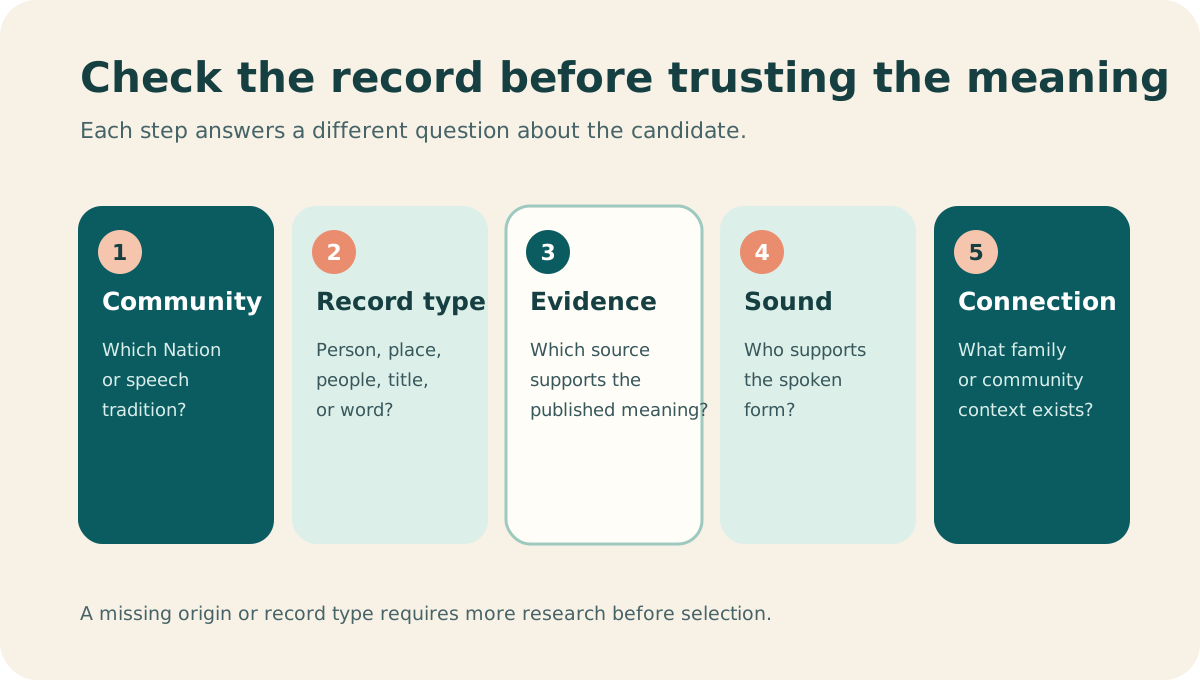
A trustworthy record answers 5 connected questions:
- Which community or speech tradition supports the spelling?
- Does the record show a person, place, people, title, or word?
- Which source supports the stated meaning or historical context?
- Who provides a reliable pronunciation for that specific form?
- What family or community connection supports its use?
A missing detail may still allow careful and thoughtful family discussion. Missing community or item type deserves more research before selection.
COMPLETE 175-NAME DIRECTORY
Names with stronger records and their history
175 names match your filters
The names below have stronger records than many commercial list entries. Each group first identifies exactly what the supporting source documents. The directory contains 175 numbered entries across several evidence levels. Visible evidence limits help parents separate records from commercial claims.
Each name block displays origin, meaning, and recorded spelling forms.
NAMES 1–3
Modern shortlist choices connected with Native peoples or places
These familiar choices connect with Native peoples, important places, or history. Modern use never converts those spellings into traditional community names.
Dakota
- Origin: Dakota people within the Oceti Sakowin community history.
- Meaning: Ally, according to Minnesota Historical Society records.
- Recorded spellings and forms: The inspected source uses Dakota alone.
For parents asking what Dakota may mean, the record answers ally.
The Minnesota Historical Society record connects Dakota with the Seven Council Fires. Parents should place that living identity before an attractive translation.
Denali
- Origin: Koyukon Athabascan place name from northern Alaska Range communities.
- Meaning: The tall one across several related northern forms.
- Recorded spellings and forms: Denali comes from older Koyukon form deenaalee.
The National Park Service record lists 9 Alaska Native mountain names. A mountain can hold many community histories.
Sequoia
- Origin: Possible Cherokee connection through Sequoyah remains uncertain.
- Meaning: No verified standalone translation appears within inspected federal material.
- Recorded spellings and forms: Sequoia and Sequoyah appear within the discussed history.
National Park Service material describes missing written evidence around the tree name. Parents should share that uncertainty whenever relatives ask about its history.
NAMES 4–13
Historical names need the person and community beside them
Historical records show that each listed entry identified a particular person. Those records never grant open use across every family or community.
Read each historical name as a person before reading its translation.
Sequoyah
- Origin: Cherokee personal name recorded for the historical syllabary creator.
- Meaning: The inspected federal record offers no verified English translation.
- Recorded spellings and forms: Sequoyah and ᏏᏉᏯ appear together.
National Park Service records connect Sequoyah with the Cherokee syllabary. Families should preserve his identity without inventing attractive nature meanings.
Tecumseh
- Origin: Shawnee personal name recorded for an influential historical leader.
- Meaning: Shooting star or celestial panther across 2 recorded accounts.
- Recorded spellings and forms: The inspected federal page writes Tecumseh.
National Park Service history records both available meaning accounts. Parents should preserve both accounts without choosing prettier commercial wording.
Osceola
- Origin: Seminole adult name of a prominent 19th-century warrior.
- Meaning: Black drink singer within a documented purification rite.
- Recorded spellings and forms: The inspected federal record writes Osceola.
National Park Service history links the name with yaupon holly. A short translation cannot capture its complete cultural history.
Cochise
- Origin: Chokonen Chiricahua name recorded during Apache Wars history.
- Meaning: The inspected federal material provides no reliable translation.
- Recorded spellings and forms: The federal history page writes Cochise.
Federal history records establish his identity and community. An honest answer protects families when reliable evidence ends.
Taza
- Origin: Chiricahua name recorded for the eldest son of Cochise.
- Meaning: The inspected record provides no supported English translation.
- Recorded spellings and forms: Federal history presents the spelling Taza.
Federal records identify Taza as a historical Chiricahua person. Informed community knowledge should support any pronunciation claim.
Juh
- Origin: Chiricahua Apache name recorded for a historical leader.
- Meaning: Federal history leaves the English translation unanswered.
- Recorded spellings and forms: The federal page presents Juh alone.
The short written form may hide unfamiliar sounds. Federal history offers no pronunciation for the name.
Goyakla
- Origin: Apache name recorded for the historical leader called Geronimo.
- Meaning: Federal history leaves the English translation unresolved.
- Recorded spellings and forms: Goyakla and Geronimo appear together.
National Park Service history supports the historical identity. Stronger community evidence should support any future translation.
Tatanka Iyotanka
- Origin: Hunkpapa Lakota name recorded for the leader Sitting Bull.
- Meaning: The Smithsonian material supplies no verified English translation.
- Recorded spellings and forms: Tatanka Iyotanka appears beside Sitting Bull.
Smithsonian material places him within the Oceti Sakowin Nation. The full name holds a person and his historical legacy.
Makhpiya Luta
- Origin: Oglala Lakota name recorded for the leader Red Cloud.
- Meaning: Scarlet Cloud, according to the Smithsonian collection record.
- Recorded spellings and forms: Makhpiya Luta appears beside Red Cloud.
The Smithsonian collection record supports both identity and translation. The former MOM page incorrectly labeled him as Hopi.
Shab-eh-nay
- Origin: Odawa and Potawatomi name recorded for a historical leader.
- Meaning: He Who Paws Through within the federal history record.
- Recorded spellings and forms: The inspected source writes Shab-eh-nay.
National Park Service records support the translation and historical identity. Present pronunciation needs deeper local community knowledge.
NAMES 14–175
Additional reference-listed choices needing community confirmation
The following entries complete the 175-name directory requested for comparison. Parents should treat each reported origin and meaning as a research lead. Community confirmation remains necessary before any final family choice. The reference pool includes The Bump, Parents, and FamilyEducation.
Kenai
- Origin: The reference pool links Kenai with Denaʼina place connection.
- Meaning: The reference pool records flat lands as the reported meaning.
- Recorded spellings and forms: The inspected directory uses Kenai for the entry.
Cheyenne
- Origin: Inspected directories connect Cheyenne with Cheyenne people name.
- Meaning: Inspected directories connect Cheyenne with the meaning people name with disputed translation.
- Recorded spellings and forms: Cheyenne appears as the reference page spelling.
Kaya
- Origin: A commercial name collection includes Kaya under Native American origin.
- Meaning: Community evidence remains necessary before presenting the reported meaning as fact.
- Recorded spellings and forms: Secondary material displays Kaya without a verified alternate form.
Dakoda
- Origin: Secondary reference material connects Dakoda with Native American naming.
- Meaning: The available evidence cannot confirm the reported meaning independently.
- Recorded spellings and forms: The commercial list records Dakoda without another supported form.
Shayan
- Origin: Parents lists Shayan within its Native American name collection.
- Meaning: A relevant community source still needs to confirm the listed meaning.
- Recorded spellings and forms: The source collection displays Shayan without another verified form.
Alaska
- Origin: FamilyEducation includes Alaska among its Native American baby names.
- Meaning: The listed meaning remains provisional until community evidence supports it.
- Recorded spellings and forms: Commercial directories present Alaska as the available written form.
Dakotah
- Origin: The inspected source labels Dakotah as Native American.
- Meaning: Available community records leave the commercial meaning unconfirmed at present.
- Recorded spellings and forms: The reviewed listing records only the spelling Dakotah.
Cree
- Origin: Commercial directories connect Cree with broad Native American use.
- Meaning: Parents should treat the listed meaning as an unconfirmed research lead.
- Recorded spellings and forms: Reference material provides Cree without a supported spelling variant.
Kree
- Origin: The source collection places Kree inside its Native American directory.
- Meaning: The commercial translation needs stronger evidence from a relevant community.
- Recorded spellings and forms: The available commercial source displays the form Kree.
Seneca
- Origin: Baby-name references associate Seneca with Native American naming.
- Meaning: No inspected community source supports the listed directory meaning yet.
- Recorded spellings and forms: Inspected baby-name material records Seneca as the listed form.
Takoda
- Origin: The Bump lists Takoda within its Native American directory.
- Meaning: Community confirmation remains unavailable for the commercially reported meaning.
- Recorded spellings and forms: The reference directory presents Takoda as the listed spelling.
Tennessee
- Origin: A secondary baby-name directory associates Tennessee with Native American use.
- Meaning: The reported meaning still needs confirmation from a relevant community source.
- Recorded spellings and forms: Commercial material records Tennessee as the displayed form.
Tammany
- Origin: Commercial reference material places Tammany within a Native American list.
- Meaning: No available community record confirms the commercial translation.
- Recorded spellings and forms: The inspected directory uses Tammany for the entry.
Senecca
- Origin: The inspected reference presents Senecca as a Native American choice.
- Meaning: The commercial meaning remains a research lead pending community evidence.
- Recorded spellings and forms: Senecca appears as the reference page spelling.
Shawney
- Origin: A commercial name collection includes Shawney under Native American origin.
- Meaning: Community evidence remains necessary before presenting the reported meaning as fact.
- Recorded spellings and forms: Secondary material displays Shawney without a verified alternate form.
Pawnee
- Origin: Secondary reference material connects Pawnee with Native American naming.
- Meaning: The available evidence cannot confirm the reported meaning independently.
- Recorded spellings and forms: The commercial list records Pawnee without another supported form.
Chayton
- Origin: Secondary references connect Chayton with Sioux reported origin.
- Meaning: Secondary references attach the meaning falcon to Chayton.
- Recorded spellings and forms: The source collection displays Chayton without another verified form.
Chicago
- Origin: FamilyEducation includes Chicago among its Native American baby names.
- Meaning: The listed meaning remains provisional until community evidence supports it.
- Recorded spellings and forms: Commercial directories present Chicago as the available written form.
Chaska
- Origin: The reference pool links Chaska with Lakota reported origin.
- Meaning: The reference pool records first-born son as the reported meaning.
- Recorded spellings and forms: The reviewed listing records only the spelling Chaska.
Quana
- Origin: Commercial directories connect Quana with broad Native American use.
- Meaning: Parents should treat the listed meaning as an unconfirmed research lead.
- Recorded spellings and forms: Reference material provides Quana without a supported spelling variant.
Senneca
- Origin: The source collection places Senneca inside its Native American directory.
- Meaning: The commercial translation needs stronger evidence from a relevant community.
- Recorded spellings and forms: The available commercial source displays the form Senneca.
Sequoya
- Origin: Baby-name references associate Sequoya with Native American naming.
- Meaning: No inspected community source supports the listed directory meaning yet.
- Recorded spellings and forms: Inspected baby-name material records Sequoya as the listed form.
Kinta
- Origin: The Bump lists Kinta within its Native American directory.
- Meaning: Community confirmation remains unavailable for the commercially reported meaning.
- Recorded spellings and forms: The reference directory presents Kinta as the listed spelling.
Orenda
- Origin: A secondary baby-name directory associates Orenda with Native American use.
- Meaning: The reported meaning still needs confirmation from a relevant community source.
- Recorded spellings and forms: Commercial material records Orenda as the displayed form.
Saquoia
- Origin: Commercial reference material places Saquoia within a Native American list.
- Meaning: No available community record confirms the commercial translation.
- Recorded spellings and forms: The inspected directory uses Saquoia for the entry.
Jagur
- Origin: The inspected reference presents Jagur as a Native American choice.
- Meaning: The commercial meaning remains a research lead pending community evidence.
- Recorded spellings and forms: Jagur appears as the reference page spelling.
Shoshone
- Origin: A commercial name collection includes Shoshone under Native American origin.
- Meaning: Community evidence remains necessary before presenting the reported meaning as fact.
- Recorded spellings and forms: Secondary material displays Shoshone without a verified alternate form.
Shayanne
- Origin: Secondary reference material connects Shayanne with Native American naming.
- Meaning: The available evidence cannot confirm the reported meaning independently.
- Recorded spellings and forms: The commercial list records Shayanne without another supported form.
Shawnie
- Origin: Parents lists Shawnie within its Native American name collection.
- Meaning: A relevant community source still needs to confirm the listed meaning.
- Recorded spellings and forms: The source collection displays Shawnie without another verified form.
Sacoya
- Origin: FamilyEducation includes Sacoya among its Native American baby names.
- Meaning: The listed meaning remains provisional until community evidence supports it.
- Recorded spellings and forms: Commercial directories present Sacoya as the available written form.
Secoya
- Origin: The inspected source labels Secoya as Native American.
- Meaning: Available community records leave the commercial meaning unconfirmed at present.
- Recorded spellings and forms: The reviewed listing records only the spelling Secoya.
Yosemite
- Origin: Commercial directories connect Yosemite with broad Native American use.
- Meaning: Parents should treat the listed meaning as an unconfirmed research lead.
- Recorded spellings and forms: Reference material provides Yosemite without a supported spelling variant.
Chayan
- Origin: The source collection places Chayan inside its Native American directory.
- Meaning: The commercial translation needs stronger evidence from a relevant community.
- Recorded spellings and forms: The available commercial source displays the form Chayan.
Hiawatha
- Origin: Commercial references link Hiawatha with Haudenosaunee historical connection.
- Meaning: Commercial references describe Hiawatha through the meaning he who combs.
- Recorded spellings and forms: Inspected baby-name material records Hiawatha as the listed form.
Saquoya
- Origin: The Bump lists Saquoya within its Native American directory.
- Meaning: Community confirmation remains unavailable for the commercially reported meaning.
- Recorded spellings and forms: The reference directory presents Saquoya as the listed spelling.
Numa
- Origin: A secondary baby-name directory associates Numa with Native American use.
- Meaning: The reported meaning still needs confirmation from a relevant community source.
- Recorded spellings and forms: Commercial material records Numa as the displayed form.
Dekota
- Origin: Commercial reference material places Dekota within a Native American list.
- Meaning: No available community record confirms the commercial translation.
- Recorded spellings and forms: The inspected directory uses Dekota for the entry.
Sitka
- Origin: The inspected reference presents Sitka as a Native American choice.
- Meaning: The commercial meaning remains a research lead pending community evidence.
- Recorded spellings and forms: Sitka appears as the reference page spelling.
Ukiah
- Origin: A commercial name collection includes Ukiah under Native American origin.
- Meaning: Community evidence remains necessary before presenting the reported meaning as fact.
- Recorded spellings and forms: Secondary material displays Ukiah without a verified alternate form.
Dasan
- Origin: Secondary reference material connects Dasan with Native American naming.
- Meaning: The available evidence cannot confirm the reported meaning independently.
- Recorded spellings and forms: The commercial list records Dasan without another supported form.
Bayou
- Origin: Parents lists Bayou within its Native American name collection.
- Meaning: A relevant community source still needs to confirm the listed meaning.
- Recorded spellings and forms: The source collection displays Bayou without another verified form.
Shyanna
- Origin: FamilyEducation includes Shyanna among its Native American baby names.
- Meaning: The listed meaning remains provisional until community evidence supports it.
- Recorded spellings and forms: Commercial directories present Shyanna as the available written form.
Dakodah
- Origin: The inspected source labels Dakodah as Native American.
- Meaning: Available community records leave the commercial meaning unconfirmed at present.
- Recorded spellings and forms: The reviewed listing records only the spelling Dakodah.
Salish
- Origin: Commercial directories connect Salish with broad Native American use.
- Meaning: Parents should treat the listed meaning as an unconfirmed research lead.
- Recorded spellings and forms: Reference material provides Salish without a supported spelling variant.
Shawnee
- Origin: The source collection places Shawnee inside its Native American directory.
- Meaning: The commercial translation needs stronger evidence from a relevant community.
- Recorded spellings and forms: The available commercial source displays the form Shawnee.
Erie
- Origin: Baby-name references associate Erie with Native American naming.
- Meaning: No inspected community source supports the listed directory meaning yet.
- Recorded spellings and forms: Inspected baby-name material records Erie as the listed form.
Quanah
- Origin: The Bump lists Quanah within its Native American directory.
- Meaning: Community confirmation remains unavailable for the commercially reported meaning.
- Recorded spellings and forms: The reference directory presents Quanah as the listed spelling.
Tacoma
- Origin: A secondary baby-name directory associates Tacoma with Native American use.
- Meaning: The reported meaning still needs confirmation from a relevant community source.
- Recorded spellings and forms: Commercial material records Tacoma as the displayed form.
Nashoba
- Origin: The reference pool links Nashoba with Choctaw reported origin.
- Meaning: The reference pool records wolf as the reported meaning.
- Recorded spellings and forms: The inspected directory uses Nashoba for the entry.
Tenaya
- Origin: The inspected reference presents Tenaya as a Native American choice.
- Meaning: The commercial meaning remains a research lead pending community evidence.
- Recorded spellings and forms: Tenaya appears as the reference page spelling.
Yura
- Origin: A commercial name collection includes Yura under Native American origin.
- Meaning: Community evidence remains necessary before presenting the reported meaning as fact.
- Recorded spellings and forms: Secondary material displays Yura without a verified alternate form.
Zuma
- Origin: Secondary reference material connects Zuma with Native American naming.
- Meaning: The available evidence cannot confirm the reported meaning independently.
- Recorded spellings and forms: The commercial list records Zuma without another supported form.
Chayanne
- Origin: Parents lists Chayanne within its Native American name collection.
- Meaning: A relevant community source still needs to confirm the listed meaning.
- Recorded spellings and forms: The source collection displays Chayanne without another verified form.
Mojave
- Origin: FamilyEducation includes Mojave among its Native American baby names.
- Meaning: The listed meaning remains provisional until community evidence supports it.
- Recorded spellings and forms: Commercial directories present Mojave as the available written form.
Mingo
- Origin: The inspected source labels Mingo as Native American.
- Meaning: Available community records leave the commercial meaning unconfirmed at present.
- Recorded spellings and forms: The reviewed listing records only the spelling Mingo.
Nashua
- Origin: Commercial directories connect Nashua with broad Native American use.
- Meaning: Parents should treat the listed meaning as an unconfirmed research lead.
- Recorded spellings and forms: Reference material provides Nashua without a supported spelling variant.
Taima
- Origin: The source collection places Taima inside its Native American directory.
- Meaning: The commercial translation needs stronger evidence from a relevant community.
- Recorded spellings and forms: The available commercial source displays the form Taima.
Shasta
- Origin: Baby-name references associate Shasta with Native American naming.
- Meaning: No inspected community source supports the listed directory meaning yet.
- Recorded spellings and forms: Inspected baby-name material records Shasta as the listed form.
Shenandoah
- Origin: The Bump lists Shenandoah within its Native American directory.
- Meaning: Community confirmation remains unavailable for the commercially reported meaning.
- Recorded spellings and forms: The reference directory presents Shenandoah as the listed spelling.
Zuni
- Origin: A secondary baby-name directory associates Zuni with Native American use.
- Meaning: The reported meaning still needs confirmation from a relevant community source.
- Recorded spellings and forms: Commercial material records Zuni as the displayed form.
Itzachu
- Origin: Commercial reference material places Itzachu within a Native American list.
- Meaning: No available community record confirms the commercial translation.
- Recorded spellings and forms: The inspected directory uses Itzachu for the entry.
Annawon
- Origin: The inspected reference presents Annawon as a Native American choice.
- Meaning: The commercial meaning remains a research lead pending community evidence.
- Recorded spellings and forms: Annawon appears as the reference page spelling.
Cetanwakuwa
- Origin: A commercial name collection includes Cetanwakuwa under Native American origin.
- Meaning: Community evidence remains necessary before presenting the reported meaning as fact.
- Recorded spellings and forms: Secondary material displays Cetanwakuwa without a verified alternate form.
Chayann
- Origin: Secondary reference material connects Chayann with Native American naming.
- Meaning: The available evidence cannot confirm the reported meaning independently.
- Recorded spellings and forms: The commercial list records Chayann without another supported form.
Comanche
- Origin: Parents lists Comanche within its Native American name collection.
- Meaning: A relevant community source still needs to confirm the listed meaning.
- Recorded spellings and forms: The source collection displays Comanche without another verified form.
Daccota
- Origin: FamilyEducation includes Daccota among its Native American baby names.
- Meaning: The listed meaning remains provisional until community evidence supports it.
- Recorded spellings and forms: Commercial directories present Daccota as the available written form.
Dakoeta
- Origin: The inspected source labels Dakoeta as Native American.
- Meaning: Available community records leave the commercial meaning unconfirmed at present.
- Recorded spellings and forms: The reviewed listing records only the spelling Dakoeta.
Dekohta
- Origin: Commercial directories connect Dekohta with broad Native American use.
- Meaning: Parents should treat the listed meaning as an unconfirmed research lead.
- Recorded spellings and forms: Reference material provides Dekohta without a supported spelling variant.
Dekowta
- Origin: The source collection places Dekowta inside its Native American directory.
- Meaning: The commercial translation needs stronger evidence from a relevant community.
- Recorded spellings and forms: The available commercial source displays the form Dekowta.
Kangi
- Origin: Commercial references link Kangi with Lakota or Dakota reported origin.
- Meaning: Commercial references describe Kangi through the meaning crow or raven.
- Recorded spellings and forms: Inspected baby-name material records Kangi as the listed form.
Mahican
- Origin: The Bump lists Mahican within its Native American directory.
- Meaning: Community confirmation remains unavailable for the commercially reported meaning.
- Recorded spellings and forms: The reference directory presents Mahican as the listed spelling.
Mandan
- Origin: A secondary baby-name directory associates Mandan with Native American use.
- Meaning: The reported meaning still needs confirmation from a relevant community source.
- Recorded spellings and forms: Commercial material records Mandan as the displayed form.
Mankato
- Origin: Commercial reference material places Mankato within a Native American list.
- Meaning: No available community record confirms the commercial translation.
- Recorded spellings and forms: The inspected directory uses Mankato for the entry.
Mendota
- Origin: The inspected reference presents Mendota as a Native American choice.
- Meaning: The commercial meaning remains a research lead pending community evidence.
- Recorded spellings and forms: Mendota appears as the reference page spelling.
Mohawk
- Origin: A commercial name collection includes Mohawk under Native American origin.
- Meaning: Community evidence remains necessary before presenting the reported meaning as fact.
- Recorded spellings and forms: Secondary material displays Mohawk without a verified alternate form.
Mohegan
- Origin: Secondary reference material connects Mohegan with Native American naming.
- Meaning: The available evidence cannot confirm the reported meaning independently.
- Recorded spellings and forms: The commercial list records Mohegan without another supported form.
Mohican
- Origin: Parents lists Mohican within its Native American name collection.
- Meaning: A relevant community source still needs to confirm the listed meaning.
- Recorded spellings and forms: The source collection displays Mohican without another verified form.
Ogaleesha
- Origin: FamilyEducation includes Ogaleesha among its Native American baby names.
- Meaning: The listed meaning remains provisional until community evidence supports it.
- Recorded spellings and forms: Commercial directories present Ogaleesha as the available written form.
Ohanzee
- Origin: The inspected source labels Ohanzee as Native American.
- Meaning: Available community records leave the commercial meaning unconfirmed at present.
- Recorded spellings and forms: The reviewed listing records only the spelling Ohanzee.
Osyka
- Origin: Commercial directories connect Osyka with broad Native American use.
- Meaning: Parents should treat the listed meaning as an unconfirmed research lead.
- Recorded spellings and forms: Reference material provides Osyka without a supported spelling variant.
Ouray
- Origin: The source collection places Ouray inside its Native American directory.
- Meaning: The commercial translation needs stronger evidence from a relevant community.
- Recorded spellings and forms: The available commercial source displays the form Ouray.
Pizi
- Origin: Baby-name references associate Pizi with Native American naming.
- Meaning: No inspected community source supports the listed directory meaning yet.
- Recorded spellings and forms: Inspected baby-name material records Pizi as the listed form.
Powhatan
- Origin: The Bump lists Powhatan within its Native American directory.
- Meaning: Community confirmation remains unavailable for the commercially reported meaning.
- Recorded spellings and forms: The reference directory presents Powhatan as the listed spelling.
Sassacus
- Origin: A secondary baby-name directory associates Sassacus with Native American use.
- Meaning: The reported meaning still needs confirmation from a relevant community source.
- Recorded spellings and forms: Commercial material records Sassacus as the displayed form.
Seminole
- Origin: Commercial reference material places Seminole within a Native American list.
- Meaning: No available community record confirms the commercial translation.
- Recorded spellings and forms: The inspected directory uses Seminole for the entry.
Shiriki
- Origin: The inspected reference presents Shiriki as a Native American choice.
- Meaning: The commercial meaning remains a research lead pending community evidence.
- Recorded spellings and forms: Shiriki appears as the reference page spelling.
Tadi
- Origin: A commercial name collection includes Tadi under Native American origin.
- Meaning: Community evidence remains necessary before presenting the reported meaning as fact.
- Recorded spellings and forms: Secondary material displays Tadi without a verified alternate form.
Tahoe
- Origin: Secondary reference material connects Tahoe with Native American naming.
- Meaning: The available evidence cannot confirm the reported meaning independently.
- Recorded spellings and forms: The commercial list records Tahoe without another supported form.
Tahoma
- Origin: Parents lists Tahoma within its Native American name collection.
- Meaning: A relevant community source still needs to confirm the listed meaning.
- Recorded spellings and forms: The source collection displays Tahoma without another verified form.
Taimah
- Origin: FamilyEducation includes Taimah among its Native American baby names.
- Meaning: The listed meaning remains provisional until community evidence supports it.
- Recorded spellings and forms: Commercial directories present Taimah as the available written form.
Taoimah
- Origin: The inspected source labels Taoimah as Native American.
- Meaning: Available community records leave the commercial meaning unconfirmed at present.
- Recorded spellings and forms: The reviewed listing records only the spelling Taoimah.
Uncas
- Origin: Commercial directories connect Uncas with broad Native American use.
- Meaning: Parents should treat the listed meaning as an unconfirmed research lead.
- Recorded spellings and forms: Reference material provides Uncas without a supported spelling variant.
Ut
- Origin: The source collection places Ut inside its Native American directory.
- Meaning: The commercial translation needs stronger evidence from a relevant community.
- Recorded spellings and forms: The available commercial source displays the form Ut.
Wakoyantanke
- Origin: Baby-name references associate Wakoyantanke with Native American naming.
- Meaning: No inspected community source supports the listed directory meaning yet.
- Recorded spellings and forms: Inspected baby-name material records Wakoyantanke as the listed form.
Wambleeska
- Origin: The Bump lists Wambleeska within its Native American directory.
- Meaning: Community confirmation remains unavailable for the commercially reported meaning.
- Recorded spellings and forms: The reference directory presents Wambleeska as the listed spelling.
Wanhahtah
- Origin: A secondary baby-name directory associates Wanhahtah with Native American use.
- Meaning: The reported meaning still needs confirmation from a relevant community source.
- Recorded spellings and forms: Commercial material records Wanhahtah as the displayed form.
Wapiti
- Origin: The reference pool links Wapiti with Shawnee or Cree word connection.
- Meaning: The reference pool records elk or white rump as the reported meaning.
- Recorded spellings and forms: The inspected directory uses Wapiti for the entry.
Waunakee
- Origin: The inspected reference presents Waunakee as a Native American choice.
- Meaning: The commercial meaning remains a research lead pending community evidence.
- Recorded spellings and forms: Waunakee appears as the reference page spelling.
Weayaya
- Origin: A commercial name collection includes Weayaya under Native American origin.
- Meaning: Community evidence remains necessary before presenting the reported meaning as fact.
- Recorded spellings and forms: Secondary material displays Weayaya without a verified alternate form.
Weeko
- Origin: Secondary reference material connects Weeko with Native American naming.
- Meaning: The available evidence cannot confirm the reported meaning independently.
- Recorded spellings and forms: The commercial list records Weeko without another supported form.
Wehinahpay
- Origin: Parents lists Wehinahpay within its Native American name collection.
- Meaning: A relevant community source still needs to confirm the listed meaning.
- Recorded spellings and forms: The source collection displays Wehinahpay without another verified form.
Wyandanch
- Origin: FamilyEducation includes Wyandanch among its Native American baby names.
- Meaning: The listed meaning remains provisional until community evidence supports it.
- Recorded spellings and forms: Commercial directories present Wyandanch as the available written form.
Yaholo
- Origin: The inspected source labels Yaholo as Native American.
- Meaning: Available community records leave the commercial meaning unconfirmed at present.
- Recorded spellings and forms: The reviewed listing records only the spelling Yaholo.
Zitkaduta
- Origin: Commercial directories connect Zitkaduta with broad Native American use.
- Meaning: Parents should treat the listed meaning as an unconfirmed research lead.
- Recorded spellings and forms: Reference material provides Zitkaduta without a supported spelling variant.
Shoshoni
- Origin: The source collection places Shoshoni inside its Native American directory.
- Meaning: The commercial translation needs stronger evidence from a relevant community.
- Recorded spellings and forms: The available commercial source displays the form Shoshoni.
Hulleah
- Origin: Baby-name references associate Hulleah with Native American naming.
- Meaning: No inspected community source supports the listed directory meaning yet.
- Recorded spellings and forms: Inspected baby-name material records Hulleah as the listed form.
Quannah
- Origin: The Bump lists Quannah within its Native American directory.
- Meaning: Community confirmation remains unavailable for the commercially reported meaning.
- Recorded spellings and forms: The reference directory presents Quannah as the listed spelling.
Tamaska
- Origin: A secondary baby-name directory associates Tamaska with Native American use.
- Meaning: The reported meaning still needs confirmation from a relevant community source.
- Recorded spellings and forms: Commercial material records Tamaska as the displayed form.
Adriel
- Origin: The reference pool links Adriel with Navajo reported origin.
- Meaning: The reference pool records symbol of skill as the reported meaning.
- Recorded spellings and forms: The inspected directory uses Adriel for the entry.
Ahanu
- Origin: Inspected directories connect Ahanu with Algonquin reported origin.
- Meaning: Inspected directories connect Ahanu with the meaning he laughs.
- Recorded spellings and forms: Ahanu appears as the reference page spelling.
Alo
- Origin: Baby-name sources associate Alo with unspecified Native American origin.
- Meaning: Baby-name sources present spiritual teacher as a commercial meaning.
- Recorded spellings and forms: Secondary material displays Alo without a verified alternate form.
Calian
- Origin: Commercial references link Calian with unspecified Native American origin.
- Meaning: Commercial references describe Calian through the meaning warrior of life.
- Recorded spellings and forms: The commercial list records Calian without another supported form.
Hopi
- Origin: Secondary references connect Hopi with Hopi people name.
- Meaning: Secondary references attach the meaning peaceful person to Hopi.
- Recorded spellings and forms: The source collection displays Hopi without another verified form.
Jacy
- Origin: Commercial sources associate Jacy with unspecified Native American origin.
- Meaning: Commercial sources list moon as the meaning for Jacy.
- Recorded spellings and forms: Commercial directories present Jacy as the available written form.
Jalen
- Origin: The reference pool links Jalen with unspecified Native American origin.
- Meaning: The reference pool records flute as the reported meaning.
- Recorded spellings and forms: The reviewed listing records only the spelling Jalen.
Kai
- Origin: Inspected directories connect Kai with Navajo reported origin.
- Meaning: Inspected directories connect Kai with the meaning willow tree.
- Recorded spellings and forms: Reference material provides Kai without a supported spelling variant.
Kele
- Origin: Baby-name sources associate Kele with Hopi reported origin.
- Meaning: Baby-name sources present sparrow or hawk as a commercial meaning.
- Recorded spellings and forms: The available commercial source displays the form Kele.
Kosumi
- Origin: Commercial references link Kosumi with unspecified Native American origin.
- Meaning: Commercial references describe Kosumi through the meaning fishes for salmon with a spear.
- Recorded spellings and forms: Inspected baby-name material records Kosumi as the listed form.
Mato
- Origin: Secondary references connect Mato with Mandan reported origin.
- Meaning: Secondary references attach the meaning bear to Mato.
- Recorded spellings and forms: The reference directory presents Mato as the listed spelling.
Mika
- Origin: Commercial sources associate Mika with Sioux reported origin.
- Meaning: Commercial sources list raccoon as the meaning for Mika.
- Recorded spellings and forms: Commercial material records Mika as the displayed form.
Nahele
- Origin: The reference pool links Nahele with Hawaiian reported origin.
- Meaning: The reference pool records forest as the reported meaning.
- Recorded spellings and forms: The inspected directory uses Nahele for the entry.
Nodin
- Origin: Inspected directories connect Nodin with Ojibwe reported origin.
- Meaning: Inspected directories connect Nodin with the meaning wind.
- Recorded spellings and forms: Nodin appears as the reference page spelling.
Nayati
- Origin: Baby-name sources associate Nayati with unspecified Native American origin.
- Meaning: Baby-name sources present he who wrestles as a commercial meaning.
- Recorded spellings and forms: Secondary material displays Nayati without a verified alternate form.
Nuka
- Origin: Commercial references link Nuka with unspecified Native American origin.
- Meaning: Commercial references describe Nuka through the meaning younger sibling.
- Recorded spellings and forms: The commercial list records Nuka without another supported form.
Tauri
- Origin: Secondary references connect Tauri with Laguna reported origin.
- Meaning: Secondary references attach the meaning star to Tauri.
- Recorded spellings and forms: The source collection displays Tauri without another verified form.
Tokala
- Origin: Commercial sources associate Tokala with Dakota reported origin.
- Meaning: Commercial sources list fox as the meaning for Tokala.
- Recorded spellings and forms: Commercial directories present Tokala as the available written form.
Wayra
- Origin: The reference pool links Wayra with Quechua reported origin.
- Meaning: The reference pool records gust of wind as the reported meaning.
- Recorded spellings and forms: The reviewed listing records only the spelling Wayra.
Wiyot
- Origin: Inspected directories connect Wiyot with Wiyot people or river connection.
- Meaning: Inspected directories connect Wiyot with the meaning people or river name.
- Recorded spellings and forms: Reference material provides Wiyot without a supported spelling variant.
Ameyalli
- Origin: Baby-name sources associate Ameyalli with Nahuatl reported origin.
- Meaning: Baby-name sources present fountain as a commercial meaning.
- Recorded spellings and forms: The available commercial source displays the form Ameyalli.
Awena
- Origin: Commercial references link Awena with unspecified Native American origin.
- Meaning: Commercial references describe Awena through the meaning sunrise.
- Recorded spellings and forms: Inspected baby-name material records Awena as the listed form.
Chardon
- Origin: Secondary references connect Chardon with unspecified Native American origin.
- Meaning: Secondary references attach the meaning sand bar to Chardon.
- Recorded spellings and forms: The reference directory presents Chardon as the listed spelling.
Chetan
- Origin: Commercial sources associate Chetan with Sioux reported origin.
- Meaning: Commercial sources list hawk as the meaning for Chetan.
- Recorded spellings and forms: Commercial material records Chetan as the displayed form.
Chimalus
- Origin: The reference pool links Chimalus with unspecified Native American origin.
- Meaning: The reference pool records bluebird as the reported meaning.
- Recorded spellings and forms: The inspected directory uses Chimalus for the entry.
Citali
- Origin: Inspected directories connect Citali with Nahuatl reported origin.
- Meaning: Inspected directories connect Citali with the meaning star.
- Recorded spellings and forms: Citali appears as the reference page spelling.
Citana
- Origin: Baby-name sources associate Citana with unspecified Native American origin.
- Meaning: Baby-name sources present star in the sky as a commercial meaning.
- Recorded spellings and forms: Secondary material displays Citana without a verified alternate form.
Esadowa
- Origin: Commercial references link Esadowa with unspecified Native American origin.
- Meaning: Commercial references describe Esadowa through the meaning wolves.
- Recorded spellings and forms: The commercial list records Esadowa without another supported form.
Kabecka
- Origin: Secondary references connect Kabecka with unspecified Native American origin.
- Meaning: Secondary references attach the meaning twin to Kabecka.
- Recorded spellings and forms: The source collection displays Kabecka without another verified form.
Kansas
- Origin: Commercial sources associate Kansas with Kaw people connection.
- Meaning: Commercial sources list people of the south wind as the meaning for Kansas.
- Recorded spellings and forms: Commercial directories present Kansas as the available written form.
Kanza
- Origin: The reference pool links Kanza with Kaw people connection.
- Meaning: The reference pool records wind people as the reported meaning.
- Recorded spellings and forms: The reviewed listing records only the spelling Kanza.
Karuk
- Origin: Inspected directories connect Karuk with Karuk people name.
- Meaning: Inspected directories connect Karuk with the meaning upriver people.
- Recorded spellings and forms: Reference material provides Karuk without a supported spelling variant.
Kentucky
- Origin: Baby-name sources associate Kentucky with place-name connection.
- Meaning: Baby-name sources present reported land of tomorrow as a commercial meaning.
- Recorded spellings and forms: The available commercial source displays the form Kentucky.
Kimeya
- Origin: Commercial references link Kimeya with unspecified Native American origin.
- Meaning: Commercial references describe Kimeya through the meaning singing throat.
- Recorded spellings and forms: Inspected baby-name material records Kimeya as the listed form.
Kishil
- Origin: Secondary references connect Kishil with unspecified Native American origin.
- Meaning: Secondary references attach the meaning night to Kishil.
- Recorded spellings and forms: The reference directory presents Kishil as the listed spelling.
Meztli
- Origin: Commercial sources associate Meztli with Nahuatl reported origin.
- Meaning: Commercial sources list moon as the meaning for Meztli.
- Recorded spellings and forms: Commercial material records Meztli as the displayed form.
Pala
- Origin: The reference pool links Pala with unspecified Native American origin.
- Meaning: The reference pool records like a guardian as the reported meaning.
- Recorded spellings and forms: The inspected directory uses Pala for the entry.
Pillan
- Origin: Inspected directories connect Pillan with Mapuche reported origin.
- Meaning: Inspected directories connect Pillan with the meaning storm spirit.
- Recorded spellings and forms: Pillan appears as the reference page spelling.
Tarlo
- Origin: Baby-name sources associate Tarlo with unspecified Native American origin.
- Meaning: Baby-name sources present bear cub as a commercial meaning.
- Recorded spellings and forms: Secondary material displays Tarlo without a verified alternate form.
Teneca
- Origin: Commercial references link Teneca with unspecified Native American origin.
- Meaning: Commercial references describe Teneca through the meaning person with self-restraint.
- Recorded spellings and forms: The commercial list records Teneca without another supported form.
Saloso
- Origin: Secondary references connect Saloso with unspecified Native American origin.
- Meaning: Secondary references attach the meaning wild goose cry to Saloso.
- Recorded spellings and forms: The source collection displays Saloso without another verified form.
Cherokee
- Origin: Commercial sources associate Cherokee with Cherokee people name.
- Meaning: Commercial sources list people name as the meaning for Cherokee.
- Recorded spellings and forms: Commercial directories present Cherokee as the available written form.
Elan
- Origin: The reference pool links Elan with commercially reported Native connection.
- Meaning: The reference pool records friendly as the reported meaning.
- Recorded spellings and forms: The reviewed listing records only the spelling Elan.
Opa
- Origin: Inspected directories connect Opa with Choctaw reported origin.
- Meaning: Inspected directories connect Opa with the meaning owl.
- Recorded spellings and forms: Reference material provides Opa without a supported spelling variant.
Tyee
- Origin: Baby-name sources associate Tyee with Chinook Jargon connection.
- Meaning: Baby-name sources present chief or leader as a commercial meaning.
- Recorded spellings and forms: The available commercial source displays the form Tyee.
Dohasan
- Origin: Commercial references link Dohasan with Kiowa historical connection.
- Meaning: Commercial references describe Dohasan through the meaning little bluff.
- Recorded spellings and forms: Inspected baby-name material records Dohasan as the listed form.
Goyathlay
- Origin: Secondary references connect Goyathlay with Apache historical connection.
- Meaning: Secondary references attach the meaning person who yawns to Goyathlay.
- Recorded spellings and forms: The reference directory presents Goyathlay as the listed spelling.
Holata
- Origin: Commercial sources associate Holata with Seminole reported origin.
- Meaning: Commercial sources list alligator as the meaning for Holata.
- Recorded spellings and forms: Commercial material records Holata as the displayed form.
Keokuk
- Origin: The reference pool links Keokuk with Sauk historical connection.
- Meaning: The reference pool records watchful person as the reported meaning.
- Recorded spellings and forms: The inspected directory uses Keokuk for the entry.
Lúta
- Origin: Inspected directories connect Lúta with Lakota reported origin.
- Meaning: Inspected directories connect Lúta with the meaning red.
- Recorded spellings and forms: Lúta appears as the reference page spelling.
Onacona
- Origin: Baby-name sources associate Onacona with Cherokee reported origin.
- Meaning: Baby-name sources present white owl as a commercial meaning.
- Recorded spellings and forms: Secondary material displays Onacona without a verified alternate form.
Sahale
- Origin: Commercial references link Sahale with Salish reported origin.
- Meaning: Commercial references describe Sahale through the meaning high place.
- Recorded spellings and forms: The commercial list records Sahale without another supported form.
Seattle
- Origin: Secondary references connect Seattle with Duwamish and Suquamish historical connection.
- Meaning: Secondary references attach the meaning historical personal name to Seattle.
- Recorded spellings and forms: The source collection displays Seattle without another verified form.
Yuma
- Origin: Commercial sources associate Yuma with Quechan people connection.
- Meaning: Commercial sources list people name as the meaning for Yuma.
- Recorded spellings and forms: Commercial directories present Yuma as the available written form.
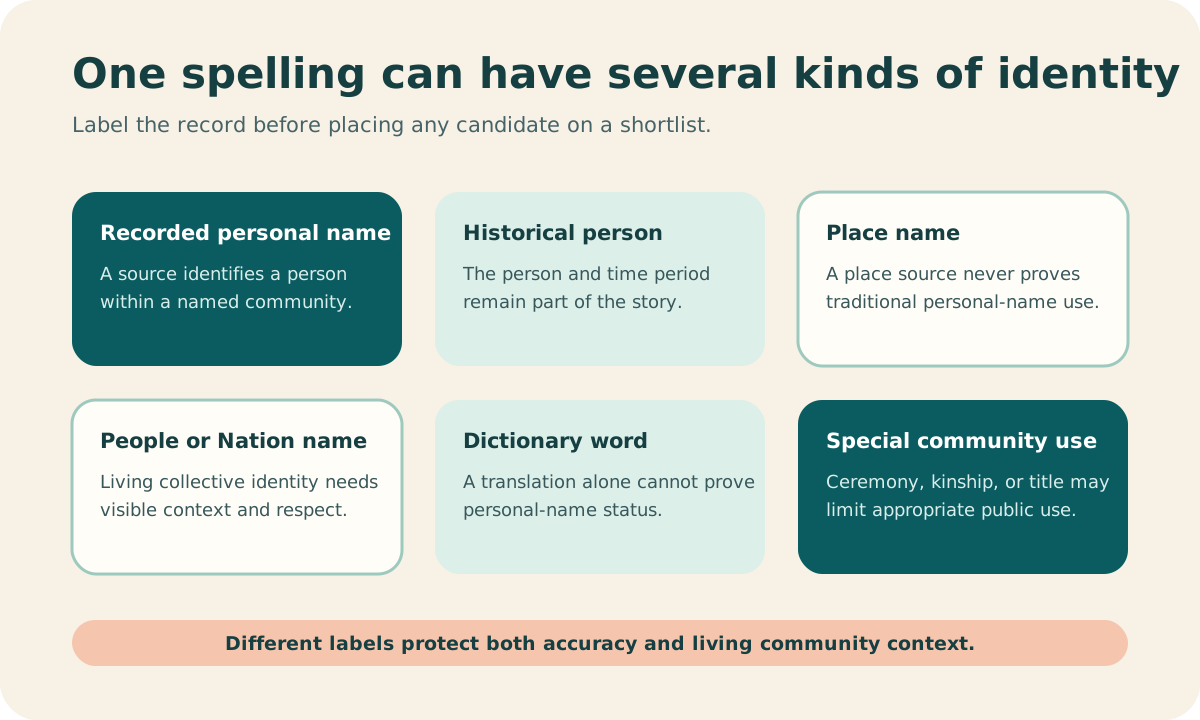
Words, Nation names, and special identities are different choices
Dictionary words can inspire parents without becoming proven personal names. A dictionary entry confirms only spelling, grammar, and recorded definitions.
Translation never automatically creates a documented personal name. A word like wolf still needs personal-name evidence.
The Ojibwe Peoples Dictionary shows how detailed and specific naming vocabulary can become. Its records distinguish namesakes, personal names, spirit names, and naming ceremonies.
Those differences expose a common commercial-list error. Translating “wind,” “bear,” or “eagle” never proves personal-name use.
Nation names deserve their own accurate and respectful label. Kiowa, Cherokee, Dakota, and Cheyenne identify living peoples and governments.
Some modern families use those forms as given names. Modern use and traditional origin remain separate questions.
If Cheyenne reaches your family list, write both factual answers down. Answer 1 covers current use; answer 2 names the living people.
What popularity data can prove about a candidate
Popularity records can confirm recent use for an exact spelling. They cannot establish origin, translation, pronunciation, or community approval. The Social Security Administration publishes national naming files for every available birth year. Those records come from Social Security card applications for United States births.
Federal files omit names with fewer than 5 occurrences per area. An absent spelling may still have several unreported uses within families. Federal files count every recorded spelling variant separately. Combining variants can hide meaningful differences between original source spellings.
Check community sources before opening any popularity files. Reversing that order can attach a false cultural origin.
Popularity answers a narrow question about recorded American baby-name use. It cannot identify the Native community behind any spelling. Never call a name rare from top 1,000 results alone. Public federal files contain many names outside those visible rankings.
The 2025 Social Security data shows about 72% of births used top 1,000 names. The directory contains no candidate counts without verified spelling matches.
How to verify a Native American boy name
Check each candidate through 5 steps before adding it. Pause whenever a claim appears only across repeated commercial lists.
1. Name the specific community
Replace broad labels with the relevant Nation or speech tradition whenever possible. “Native American” alone cannot support precise translation or trustworthy pronunciation. Search the Nation cultural department, education office, or dictionary first. University projects created with community speakers can also support families.
A page naming only “Sioux” still needs a closer source review. Dakota, Lakota, and Nakota sources may record different written forms.
2. Identify the record type
Ask what the source actually documents about the spelling. Personal names, places, peoples, special titles, and ordinary words need different labels. Historical names need their person, period, and community beside them. Place names need the history behind their later English form.
Write the item type beside every shortlisted name. That short note prevents several common and costly origin mistakes.
3. Check the exact source form
Compare every letter, accent mark, space, and hyphen carefully. Commercial spellings sometimes combine forms from several unrelated sources. A source supporting one spelling cannot support every creative new variant. Use the recorded form until reliable community evidence supports another spelling.
For Sequoyah, copy ᏏᏉᏯ only from a reliable Cherokee record. Never create another Cherokee spelling from familiar English sounds alone.
4. Where can families verify meaning and pronunciation?
Check translation and pronunciation through separate trusted community sources. A source may accurately answer only a single research question.
Parents seeking names with pronunciation support need community audio sources.
A source may support translation without offering any pronunciation. Another may record audio without proving personal-name use.
Treat translation and pronunciation as separate and careful research jobs. Audio from community speakers deserves priority over invented English phonetic spelling.
Write unknown when no trustworthy community audio exists. Honest silence always beats a confident but unsupported sound.
5. Ask about family and community connection
Families within a community can begin with relatives and shared cultural knowledge. Naming customs may involve kinship, ceremony, family events, or respected elders.
Families outside that community should ask harder questions first. Consider living identity, sacred context, family links, and community views.
Parents can ask what family story their child will eventually hear. The honest answer should reach beyond an attractive 2-word translation.
Can parents outside a Native community use these names?
No universal rule covers every name, family, or Native community. The item type and living community relationship shape each answer.
A modern place-linked name such as Denali differs from a ceremonial identity. A historical leader name holds another person and legacy together.
3 practical questions uncover the main cultural concern.
- Does the candidate identify a living people or Nation?
- Does its history involve ceremony, kinship, title, or spiritual identity?
- Can a community source discuss current use respectfully?
When those important answers remain uncertain, pause the family shortlist. Another name can honor family history without borrowing protected cultural identity.
Never ask a stranger to approve an entire cultural decision. Seek relevant community information, listen carefully, and accept boundaries without argument.
Respect can sometimes include choosing another meaningful family name. That choice may protect a valued tradition and your child.
Build a final shortlist your family can defend
A strong family shortlist places evidence beside every emotional preference. 7 practical questions can expose missing facts before official paperwork begins.
- Which exact source form will appear on documents?
- Which specific community supports the recorded origin claim?
- What record type does the best source show?
- Which source supports the meaning, if any?
- Who can confirm pronunciation for that form?
- What family connection or respectful reason supports use?
- How will the child answer questions about the name?
Read every finalist with the complete family name aloud several times. Check initials, nicknames, spelling, and everyday pronunciation across likely settings.
Record uncertainty openly beside every unresolved candidate. “Meaning unverified” remains more honest than a polished invention.
Picture a teacher reading the chosen name from classroom attendance. Then picture your teenager describing its complete community history.
Both future moments should support the same truthful family answer.
Sources
- Smithsonian Native Knowledge 360°: Appropriate terminology
- Smithsonian Native Knowledge 360°: Essential Understandings
- Ojibwe Peoples Dictionary: Naming-related vocabulary
- Minnesota Historical Society: Dakota Homeland
- National Park Service: Naming a Mountain
- National Park Service: Cherokee Language and Sequoyah
- National Park Service: Tecumseh
- National Park Service: Osceola
- National Park Service: Cochise
- National Park Service: The Chiricahua Apache
- National Park Service: Shab-eh-nay
- Smithsonian NMAI: Tatanka Iyotanka
- Smithsonian NMAI: Makhpiya Luta
- Social Security Administration: Beyond the Top 1000 Names
- National Park Service: Sequoia name history
- Social Security Administration: Baby name data background
- The Bump: Native American boy names
- Parents: Native American baby names
- FamilyEducation: Native American baby names

Asha Tiwari
I am a professional author-cum-blogger and I take interest in posting blogs and articles on subjects related pregnancy, infertility, Parenting, Baby care etc to provide helpful information to the users. I delicately trying to help new, expectant and actively trying parents to find information, support, and answers of parenting questions. My hobby is delivering inspiring and informative multi platform content for Parents.