40 Christian Girl Names to Start Your Shortlist
These 40 Christian baby girl names form a focused shortlist across four faith connections. Each entry pairs the recorded meaning with its Christian faith connection.
Old Testament women
- Abigail: The Hebrew name joins words for father and joy; Scripture connects her with David.
- Deborah: Hebrew for bee; Judges presents her as a prophet and judge.
- Esther: Probably Persian with debated early meaning; her courage shapes her biblical story.
- Hannah: Hebrew for favour or grace; she becomes the mother of Samuel.
- Leah: Her early meaning remains uncertain; Genesis names her as the first wife of Jacob.
- Naomi: Hebrew for my pleasantness; her story forms the emotional heart of Ruth.
- Rachel: Hebrew for ewe; Genesis names her as the wife of Jacob.
- Rebekah: Her early meaning remains debated; Genesis names her as the wife of Isaac.
- Ruth: The Hebrew name likely relates to friendship; her loyalty shapes the Book of Ruth.
- Sarah: Hebrew for princess or noblewoman; Genesis connects her with Abraham.
New Testament women
- Anna: A Greek form of Hannah; the prophet recognizes Jesus in Luke.
- Damaris: Her Greek name may relate to a young calf. Acts names her among people responding to Paul.
- Elizabeth: Hebrew for my God is an oath; mother of John the Baptist.
- Joanna: The name carries Yahweh is gracious; she follows Jesus and supports his ministry.
- Junia: Her Roman name has an uncertain meaning; Romans names her among early Christians.
- Lydia: The Greek name identifies a woman from Lydia. Acts presents her as a merchant and early Christian.
- Mary: Her early meaning remains uncertain; she is the mother of Jesus.
- Martha: Aramaic for lady or mistress; she appears with Mary and Lazarus.
- Phoebe: Greek for bright or pure; Romans names her within an early Christian community.
- Priscilla: Her name comes from Latin for ancient; Acts presents her as a Christian teacher.
- Susanna: Her name comes from a Hebrew word related to lily. Luke names her among women supporting Jesus.
- Tabitha: Aramaic for gazelle; Acts describes her as a generous disciple.
Names linked with saints
- Agnes: Greek for chaste; Saint Agnes gave the name its lasting Christian connection.
- Bernadette: The French form of Bernard comes from Germanic words for brave bear. Saint Bernadette of Lourdes supplies its Christian connection.
- Bridget: The Irish-rooted name carries the sense exalted one and honors Saint Brigid.
- Cecilia: A Roman family name, Cecilia gained its Christian link through Saint Cecilia.
- Clare: Latin for bright or famous; the name also honors Saint Clare.
- Lucy: The English form of Lucia links Latin light roots with Saint Lucy.
- Monica: Her early meaning remains uncertain; Saint Monica supplies its Christian connection.
- Teresa: Her early meaning remains uncertain; several Christian saints carried the name.
Virtue names and gift names
- Charity: The English word name expresses generous love as a Christian virtue.
- Dorothy: Greek for gift of God; the name has centuries of Christian use.
- Faith: The English word name expresses trust and belief directly.
- Grace: The English word name points to divine grace and favour.
- Hope: The English word name expresses confident hope within Christian faith.
- Joy: The short English word name expresses gladness as a Christian virtue.
- Mercy: The English word name expresses compassion and forgiveness directly.
- Patience: The English word name expresses calm endurance through difficulty.
- Theodora: Greek for gift of God; its word parts reverse those within Dorothy.
- Verity: Latin for truth; Christian families may value its direct virtue meaning.
Behind the Name traces Abigail to Hebrew roots for father and joy. Its biblical feminine index records gender, origin, and scriptural context for many names above.
The linked histories cover Agnes, Bernadette, Cecilia, Clare, Dorothy, and Theodora.
Additional histories cover Lucy, Teresa, Monica, and Bridget.
What Counts as a Christian Girl Name?
Christian girl names include biblical women, saint-linked names, and Christian virtue names. A faith connection makes a girl name Christian within the collection.
A name can also come from a biblical place, word, or expression.
Names of women in the Bible
Use the alphabetical name finder for Bible names for girls. Each line shows the recorded meaning and a biblical location.
These biblical girl names include women from both Testaments. The shortlist separates Old Testament girl names from New Testament girl names.
The finder also includes uncommon biblical girl names missing from many collections.
Uncertain meanings remain marked because a Bible story cannot prove a name root. Shortlist names whose meaning, story, spelling, and family sound all work together.
- Abigail: Hebrew for my father is joy; appears in 1 Samuel.
- Achsah: Hebrew for anklet or bangle; appears in Joshua.
- Adah: Hebrew for ornament or adornment; appears in Genesis.
- Anna: A Greek form of Hannah, connected with grace; appears in Luke.
- Apphia: Her Hebrew-rooted name possibly meant increasing; appears in Philemon.
- Atarah: Hebrew for crown; appears in 1 Chronicles.
- Bathsheba: Hebrew for daughter of the oath; appears in 2 Samuel.
- Bithiah: Hebrew for daughter of Yahweh; appears in 1 Chronicles.
- Chloe: Greek for green shoot; appears in 1 Corinthians.
- Damaris: Her Greek root may refer to a young calf; appears in Acts.
- Deborah: Hebrew for bee; appears as a prophet and judge.
- Dinah: Hebrew from a word for judgment; appears as a daughter of Jacob.
- Dorcas: Greek for gazelle; Acts also records her Aramaic name, Tabitha.
- Elizabeth: Hebrew for my God is an oath; appears in Luke.
- Esther: Her early meaning remains debated; the name is probably Persian.
- Eunice: Greek for good victory; appears in 2 Timothy.
- Eve: Her Hebrew name relates to living; appears in Genesis.
- Hadassah: Hebrew for myrtle tree; appears as the Hebrew name of Esther.
- Hannah: Hebrew for favour or grace; appears in 1 Samuel.
- Hephzibah: Hebrew for my delight is in her; appears in 2 Kings.
- Huldah: Hebrew for weasel or mole; appears as an Old Testament prophet.
- Iscah: Her Hebrew meaning remains uncertain; appears in Genesis.
- Jael: Hebrew for ibex or mountain goat; appears in Judges.
- Jemima: Traditionally dove, but possibly daytime; appears in Job.
- Joanna: Hebrew-rooted for Yahweh is gracious; appears in Luke.
- Jochebed: Hebrew for Yahweh is glory; appears in Exodus.
- Judith: Hebrew for Jewish woman; appears in Genesis.
- Julia: A Roman family name with uncertain early meaning; appears in Romans.
- Junia: A Roman name with uncertain early meaning; appears in Romans.
- Keturah: Hebrew for incense; appears in Genesis.
- Keziah: Hebrew for cassia or cinnamon; appears in Job.
- Leah: Her early meaning remains uncertain; appears in Genesis.
- Lydia: Greek for a woman from Lydia; appears in Acts 16.
- Lois: Her Greek meaning remains uncertain; appears in 2 Timothy.
- Martha: Aramaic for lady or mistress; appears in the Gospels.
- Mary: Her early meaning remains uncertain; appears throughout the Gospels.
- Miriam: Her early meaning remains uncertain; appears in Exodus.
- Naomi: Hebrew for my pleasantness; appears in Ruth.
- Noa: Hebrew for motion; appears among the daughters of Zelophehad.
- Persis: Greek for a Persian woman; appears in Romans.
- Phoebe: Greek for bright or pure; appears in Romans 16.
- Priscilla: Latin for ancient; appears in Acts and Romans.
- Rachel: Hebrew for ewe; appears in Genesis.
- Rebekah: Her early meaning remains debated; appears in Genesis.
- Rhoda: Greek for rose; appears in Acts.
- Ruth: Her Hebrew name probably relates to friendship; appears in Ruth.
- Salome: Her name relates to peace; appears in Mark.
- Sarah: Hebrew for princess or noblewoman; appears in Genesis.
- Susanna: Hebrew-rooted for lily; appears in Luke.
- Tabitha: Aramaic for gazelle; appears in Acts 9.
- Tamar: Hebrew for date palm; appears in Genesis.
- Tirzah: Hebrew for favourable or delightful; appears in Numbers.
- Tryphena: Greek for softness or delicacy; appears in Romans.
- Tryphosa: Greek for softness or delicacy; appears in Romans.
- Zipporah: Hebrew for bird; appears in Exodus.
Some names have complicated stories despite appealing meanings. Read the surrounding passage before adding any unfamiliar choice.
For example, Abigail shows practical wisdom within the story of David. Deborah serves as both prophet and judge in Judges.
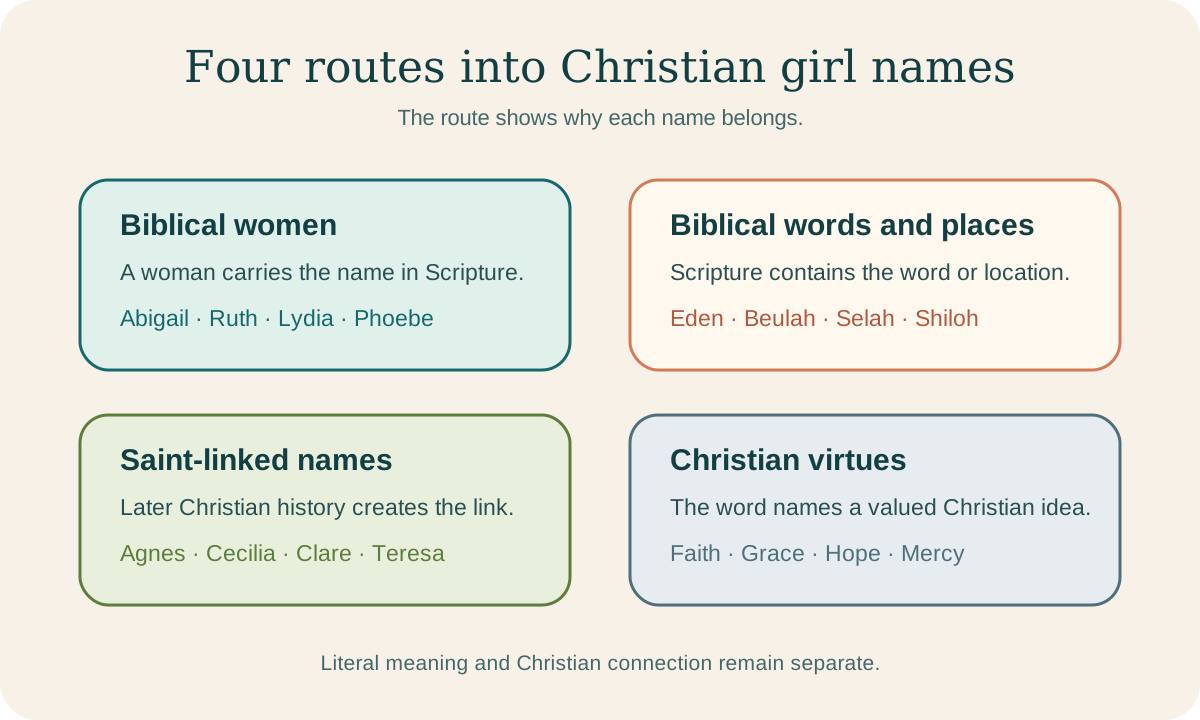
Names from biblical words and places
Some choices appear in Scripture without naming a woman. Eden and Shiloh are places, while Hosanna is a biblical expression.
Beulah is a Hebrew word applied to land. Selah is an uncertain term within the Psalms.
A place from Scripture should never become a false biblical woman.
Names linked with saints
Agnes, Cecilia, Clare, Lucy, Teresa, and Bernadette gained Christian links through saints. Their original meanings still come from older Greek, Latin, or Germanic roots.
A saint connection never changes the original meaning. Clare keeps its brightness-based Latin history while also honoring Saint Clare.
Christian virtue names
Faith, Grace, Hope, Joy, Mercy, Charity, and Patience express virtues. Their Christian link comes from the idea named within each word.
Virtue names differ from biblical personal names. Scripture discusses hope, yet Hope names no biblical woman.
Names Connected With Grace, Hope, Light, Peace, and Gift
Find Christian girl names by meaning below. Each group clearly separates names connected with grace, hope, light, peace, or a gift from God.
Grace and divine favour
Hannah and Anna express the sense of favour or grace. Joanna, Gianna, Jane, and Giovanna belong to a name family meaning Yahweh is gracious.
Grace states the Christian idea directly through an English word.
Faith and hope
Faith and Hope state their themes in plain English. Fidelia comes from a Latin word connected with faithfulness.
Esperanza uses the Spanish word for hope. Nadia connects with hope through its Slavic name history.
Light and joy
Lucia and Lucy come from a Latin name family linked with light. Clare and Clara come from Latin words related to brightness.
Phoebe carries bright or pure senses in Greek. Abigail links father and joy within its Hebrew roots.
Peace
Irene comes from a Greek word for peace. Salome comes from an Aramaic name connected with peace.
Serenity expresses peaceful calm in modern English. Its Christian link comes from that virtue.
Gift from God
Theodora, Dorothy, and Dorothea join Greek elements for God and gift. Mattea belongs to the Matthew name family, carrying a gift-of-Yahweh sense.
Joanna and Gianna belong in another meaning group. They refer to divine grace, separate from a divine gift.
Saint Names for Girls From Christian History
Saint names for girls come from women in later Christian history. These names honor Christian saints and remain outside biblical accounts.
Female saint names include Agnes, Cecilia, Clare, Lucy, Teresa, and Bernadette. Families may value different saints across Catholic, Orthodox, Anglican, or other traditions.
Agnes and Cecilia offer compact ancient forms. Both names became strongly linked with early Christian saints.
Clare and Lucy share a brightness theme. Their saint connections remain separate from their original meanings.
Teresa and Monica have long Christian use. The early history of each name remains uncertain.
Bernadette and Felicity create different styles and histories. Bernadette comes through a Germanic name family, while Felicity comes from Latin happiness vocabulary.
Bridget and Brigid connect through Irish Christian history. Families should choose the spelling used within their own tradition.
Modern and Short Christian Girl Names
Modern Christian girl names can still have ancient roots. Here, modern describes the sound; the names may still be ancient.
Fresh-sounding choices: Ariella, Eden, Eliana, Gabriella, Gianna, Noelle, Selah, Seraphina, Shiloh, and Zoe.
Eden, Selah, and Shiloh have ancient Bible links. Their short sounds pair naturally with newer names.
Short choices: Eve, Joy, Noa, Ruth, Anna, Leah, Mary, Hope, Zoe, and Grace.
Noa needs a careful spelling check before selection. The biblical female Noa differs from the male Noah, despite similar English spellings.
Indian Christian Baby Girl Names and Family Traditions
Indian Christian baby girl names reflect different regions, churches, and family histories. No single naming rule covers every Christian community in India.
Some families prefer direct biblical names such as Hannah, Sarah, Ruth, Esther, Mary, or Elizabeth. Others select saints, virtue names, local forms, or forms used elsewhere.
Kerala Syrian Christian practice can differ from Goan Catholic practice. Protestant, Orthodox, and Catholic families may also value different naming customs.
Rainbow Hospitals describes the diversity and recommends checking family or church practice. That advice protects local tradition without treating one custom as universal.
A family surname also changes the final sound. Read each full option aloud using the expected everyday pronunciation.
How to Check Spelling and Pronunciation
Choose the spelling your family can use confidently every day. Rebekah and Rebecca share one name family but look different in writing.
Clare and Claire sound alike in many English-speaking families. The female biblical Noa differs from the male Noah.
Ask relatives to pronounce the full name before making the final choice. Also check how the chosen spelling appears in family or church records.
Five Checks Before Choosing a Christian Girl Name
Use five checks to compare your final Christian names for girls.
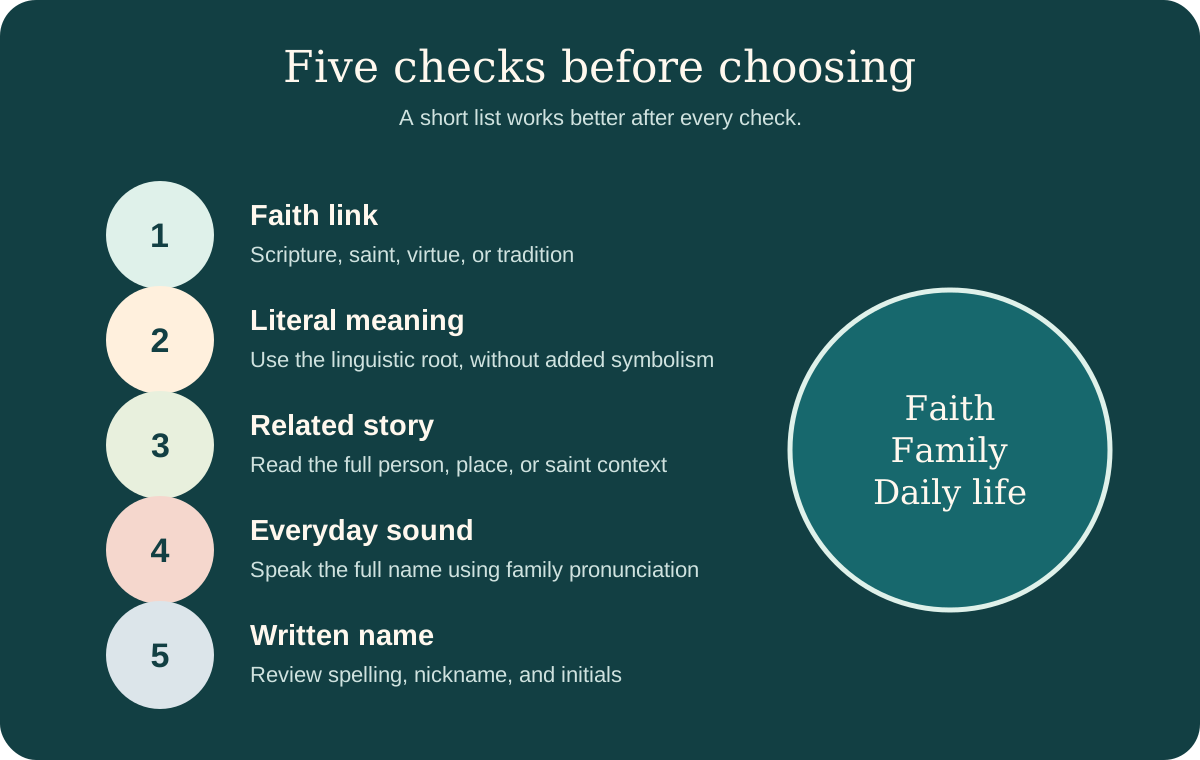
- Name the faith connection: Choose Scripture, saint, virtue, or long Christian use.
- Check the recorded meaning: Separate name history from family hopes or symbolism.
- Read the related story: Full context can matter more than one attractive word.
- Test everyday speech: Read the first, middle, and family name aloud several times.
- Check writing and initials: Review spelling, likely nickname, initials, and regional pronunciation.
Save three to five finalists for several days. Choose a name your family can pronounce, spell, and value for years.
How We Checked the Names
We checked name roots against references and biblical roles against Scripture. When experts disagree about a meaning, the article marks it as unclear.
English spellings can vary across Bible translations and regional traditions. Meaning describes linguistic history, never a promise about personality.
We left out broad popularity claims without a comparable worldwide dataset.
Sources
- Behind the Name: Biblical feminine names
- Behind the Name: Abigail
- Bible Gateway: Romans 16
- Bible Gateway: Acts 16:14–15
- Bible Gateway: Acts 9:36–42
- Rainbow Hospitals: Christian baby girl names and naming traditions
- Behind the Name: Agnes
- Behind the Name: Bernadette
- Behind the Name: Cecilia
- Behind the Name: Clare
- Behind the Name: Dorothy
- Behind the Name: Theodora
- Behind the Name: Monica
- Behind the Name: Lucy
- Behind the Name: Teresa
- Behind the Name: Bridget
- Behind the Name: Junia
- Behind the Name: Damaris
- Behind the Name: Jochebed
- Behind the Name: Huldah
- Behind the Name: Apphia
- Behind the Name: Tryphena
- Behind the Name: Tryphosa
- Behind the Name: Julia
- Behind the Name: Bathsheba
- Behind the Name: Jemima