Three National Babysitting Rates Measure Different Things
Families see different national averages because websites track different prices. None covers every babysitting job across the United States.
| Source | 2026 hourly figure | What the figure measures |
|---|---|---|
| UrbanSitter booking study | $26.24 | Website booking payments for one child |
| Care.com listing study | $19.81 | Posted starting prices among listed sitters |
| Sittercity rate table | $23.00 | Typical national babysitter rate |
A listed price can rise after you share full job details. Booking payments may include details missing from many profile prices. Typical rates may come from different records or math.
Never combine these three figures into one national babysitting average. Each number answers a different parent question.
Booking amounts show what some families paid through that website. Nearby profiles show listed prices before discussing your job. Matching local quotes show what sitters would charge your family.
Use each benchmark during a different hiring step.
- Booking payments: Review amounts families accepted through the same booking website.
- Profile listings: Check prices from sitters available near your home.
- Direct quotes: Compare payment for your individual assignment.
A low profile price may exclude duties discussed later. An accepted quote should name children, hours, duties, and added expenses. Compare dollar amounts only after matching every listed term.
Three reported rates measure different pricing stages
Compare the label beside each number before using its price.
Compare 2026 Babysitting Rates Across Six Cities
Babysitting rates can change greatly between cities. Using one website makes these city prices easier to compare.
UrbanSitter reports these website booking averages for 2026.
| City area | One child | Two children |
|---|---|---|
| San Antonio, Texas | $18.21 | $21.94 |
| Atlanta, Georgia | $20.78 | $23.74 |
| Chicago, Illinois | $22.21 | $25.83 |
| Denver, Colorado | $24.05 | $26.60 |
| Seattle, Washington | $27.70 | $30.79 |
| San Francisco, California | $29.63 | $33.70 |
San Francisco costs $11.42 more than San Antonio for one child. Even nearby neighborhoods may have different prices.
Enter your ZIP code into a babysitter rate calculator. Its result may differ because local ZIP-level numbers update at another time. Then send identical details to two or three nearby sitters. Include all child ages, start time, end time, duties, and location.
Matching job details make price checks fairer.
Ask for quotes covering the same exact date and time window. Ask if weekend evenings, holidays, or short notice change prices. Ask about minimum hours before comparing each proposed total.
Use three checks before accepting one price.
- Distance: Compare profiles within a practical distance from your home address.
- Job details: Send identical information to every sitter you contact.
- Complete totals: Add every listed minimum and travel charge before comparing.
One distant low rate may lose value after travel costs. A nearby sitter may quote more while charging fewer added expenses. Your final comparison should use the entire expected booking price.

Babysitting Rates for Two or Three Children
Babysitting rates rise when one sitter watches more children. UrbanSitter lists these 2026 national booking averages.
- One child: National bookings average $26.24 for each paid hour.
- Two children: Bookings average $29.87 for each paid hour.
- Three children: Bookings average $32.33 within the 2026 UrbanSitter study.
Comparing these averages, a second child adds $3.63 hourly. A third child adds $2.46 across separate bookings. Individual sitter quotes may differ from both added national amounts.
- Babies: Child ages can change duties and hourly prices. Babies may need bottles, diaper changes, and much closer supervision.
- Older children: They may sometimes need homework help, meals, or rides.
- Routine details: Tell each sitter about feeding, bedtime, movement needs, medicines, and sleep routines. One national infant fee cannot cover every family routine.
- Recent experience: Ask about experience with each relevant child age group. Watching infants needs different experience than watching older children. Training can affect prices, yet no standard training fee exists.
- Different households: Two families with two children can still receive different hourly quotes. One household may have schoolchildren needing little help during familiar bedtime routines. Another may include bottles, diapers, medicines, and several nighttime wakings. Describe every routine before accepting any quoted amount.
Share details affecting workload before requesting a firm amount.
- Ages and routines: Name each child age and current daily routine.
- Daily needs: Describe feeding, toileting, sleep, and movement needs.
- Medicines: List instructions requiring full sitter agreement and readiness beforehand.
- Close supervision: Mention any child needing one-person attention.
These details help each sitter price the actual responsibility fairly. They also prevent surprise duties after the booking begins.
Price the Assignment Before Comparing Sitters
Two sitters may offer the same hourly price for different jobs. Describe the whole job before comparing two sitters.
List common child duties within the main babysitting job.
- Supervision: Watch every child during all agreed paid job hours.
- Food: Serve prepared meals and parent-approved snacks when requested during the booking.
- Routines: Cover bedtime, play, homework, and child-related cleanup.
- Instructions: Follow written parent directions for feeding or medicines.
- Updates: Contact parents at agreed times or after important incidents.
Extra household work may require separate payment.
- Adult meals: Cook food for adults or the whole household.
- Housework: Complete family laundry or broad household cleaning.
- Driving: Cover planned school pickups, activities, or household errands.
- Pet work: Cover longer duties beyond quick feeding or outdoor breaks.
Agree who provides the vehicle before adding transport duties. Record mileage, parking, tolls, and activity costs as separate amounts.
Small task differences can change the complete quote. Serving a prepared dinner differs from cooking an adult meal. Child-related cleanup differs from cleaning several household rooms.
Write every requested task before asking for payment terms. Ask which duties belong inside the hourly price. Place every extra task and amount within the accepted message. Confirm every addition before the sitter accepts payment terms.
Avoid adding household work after the sitter arrives. Late additions can create disagreement about time and payment. A complete task list protects both people during the booking.
Calculate Babysitting Cost for Four, Six, or Eight Hours
Use the accepted hourly rate and paid hours to calculate base pay. Add separate expenses after finding the base sitter payment.
Agreed hourly rate × paid hours = base sitter pay
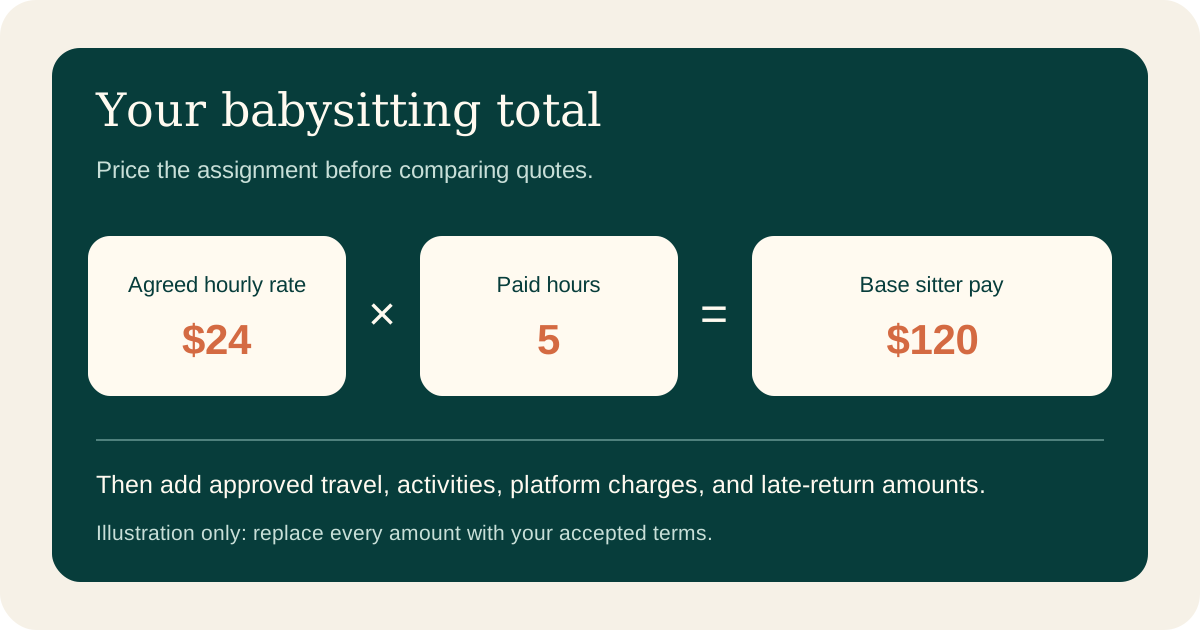
Use the accepted rate and paid hours, then add each approved extra cost.
The examples below use $26.24 only as a sample rate. Each total covers base sitter pay only.
- Four hours: Total base sitter pay reaches $104.96 at $26.24 hourly.
- Six hours: Sitter pay reaches $157.44 at that rate.
- Eight hours: Base sitter pay reaches $209.92 at that rate.
Replace $26.24 with the final agreed hourly amount your sitter accepted.
Count arrival and parent handoff within paid time. Agree exactly when payment ends after the planned return time. Decide how an unexpected late return changes the total.
Minimum hours can raise prices for short bookings. Under some policies, a two-hour visit requires three paid hours.
Ask about booking minimums before comparing posted hourly prices.
Decide how both people will count partial hours. At $24 hourly, thirty minutes equals $12 when counting exact time. Fifteen minutes equals $6 under that same calculation.
Another agreement may use fixed payment intervals. Write the chosen interval before the booking begins. Record any minimum payment separately from actual written scheduled hours. Both people should save the accepted timing rule.
Use one calculation order when reviewing every quote comparison.
- Rate: Confirm the exact final accepted hourly amount with the sitter.
- Paid time: Count every hour under the written timing terms.
- Base pay: Multiply the accepted rate and paid hours.
- Added costs: Include approved expenses after checking each listed amount.
That order prevents fees from hiding inside hourly comparisons.

Overnight Bookings Need Written Time and Wake-Up Terms
Overnight babysitter cost depends on total hours and child wake-ups. Parents and sitters need three written terms before booking.
- Booking window: Record exact arrival and departure times for the job.
- Sleep period: Separate active hours from any agreed sleeping period.
- Wake-ups: State how waking children change agreed sleeping-time prices.
- Whole-night hourly pay: Some families pay hourly across the entire night. Others combine active-hour pay with an agreed sleep amount. Local wage rules can limit overnight payment choices.
- Federal boundary: When federal rules apply, required home time counts as paid work. Federal law has a narrow exception for casual babysitters. State or city rules can protect more workers.
- Worked example: Suppose the sitter works four active hours at $24. Base pay reaches $96 before any sleeping-time amount. Add only the sleep amount both parties accepted beforehand.
- Wake-up work: Repeated wake-ups add active work during the night. Write how feeds, medicine, or long awake periods change final payment.
- Responsibility: The sitter remains in charge for the entire agreed overnight period. Child sleep leaves overnight responsibility active during all booked hours. The sitter must respond when a child needs help. Discuss expected feeds, bathroom trips, medicines, and morning routines together beforehand.
- Final agreement: A parent expecting uninterrupted sleep should always discuss wake-up payment. A sitter expecting several overnight feeds needs that workload inside the final quote. Both people should confirm the complete overnight amount together in writing. Save those overnight terms beside the final booking.
Add Fees and Expenses to Find the Complete Bill
The hourly amount may cover only your base sitter pay. Travel, planned activities, and booking website charges can raise your final total.
Write each amount before confirming the booking.
- Base sitter pay: Agreed hourly rate multiplied across all paid hours: $_____.
- Website charges: Any agency or platform amount shown during checkout: $_____.
- Travel costs: Approved mileage, parking, tolls, or transport: $_____.
- Child expenses: Approved activity tickets, planned meals, or necessary supplies: $_____.
- Late return: Agreed payment after the planned ending time: $_____.
- Complete total: Base pay with every approved listed charge added: $_____.
Five hours at $24 produce $120 base pay. An approved $12 ride raises that amount to $132. Add any booking website charges only after checking checkout terms.
Review every checkout and payment term before sending payment. Ask which expenses need approval before anyone makes planned purchases.
Cancellation terms can create costs before babysitting begins. Record notice periods and cancellation amounts beside payment details. Both people can then check the same written cancellation amount later.
Agree when payment arrives and which exact payment method both people accept. Save a receipt, payment screen, or written payment confirmation afterward. Recurring bookings need separate records for each payment date. Store every recurring payment record within one secure household folder.
Refunds and booking credits may follow website rules. Read all checkout terms before sending money through any booking platform. Direct payments still need written hours, expenses, and cancellation terms.
Send Every Sitter the Same Quote Request
Fair quotes need one complete job description. Send the same dates, hours, children, duties, and expense questions.
A parent could send one short message containing all needed details.
Please quote four hours next Saturday evening for two children. They are ages three and eight and need dinner and bedtime. The booking runs from 6 p.m. until 10 p.m., including every travel charge.
Add any baby tasks, medicines, pets, driving, or household work. Ask each sitter to confirm the hourly price and added charges.
Before accepting, check five details in writing.
- Price: Confirm the exact hourly price or agreed flat payment amount.
- Paid hours: Confirm exact start and finish times for payment.
- Duties: List child tasks and agreed prices for added household work.
- Expenses: List approved costs and any booking website charges.
- Changes: Record accepted cancellation and late-return terms for both people.
Save the accepted message beside your final booking receipt.
Compare replies in the same order carefully after every sitter responds. Start with the complete booking total before considering hourly price. Then compare included duties, time rules, travel charges, and cancellation terms.
Ask one written follow-up question whenever a reply omits an important detail. A short written answer can prevent one costly payment assumption. Never fill an unanswered space using another sitter agreement. Request every missing term before choosing a sitter.
Recurring Babysitting Can Create Wage and Payroll Duties
Federal rules may treat a regular home sitter as your household employee. Worker status depends on job control, payments, age, and listed exceptions.
IRS Publication 926 looks at who controls the work details. Your job directions, home equipment, and recurring duties can support employee status. Calling someone a contractor cannot settle the issue.
For 2026, federal tax rules may begin at $3,000 cash for one worker. Social Security and Medicare taxes may apply at $3,000. IRS rules list exceptions for relatives and younger workers. Federal unemployment tax uses a separate $1,000 household wage test each quarter. That amount may include wages paid to several different household workers.
Track every payment to each recurring worker during the year. Check every state payroll, insurance, and wage rule on its own. Ask a payroll professional when worker status remains uncertain.
Some work-related babysitting expenses may qualify for a federal credit. Families use the current Form 2441 when claiming that federal credit.
Your household and hiring reason affect the possible credit.
Save each provider name, address, taxpayer ID, and payment record. Form 2441 asks families for those provider details. IRS Publication 503 lists steps when a family cannot get that ID.
Tax credits and payroll duties use separate tests, and some households face both. Use a short useful record list from the first recurring payment.
- Payments: Record each date, amount, and covered work period.
- Worker details: Save the sitter name, address, and requested tax information.
- Work records: Retain written schedules, duties, receipts, and expense repayments.
- Annual totals: Check every total before reaching the federal wage threshold.
Good records make later payroll questions easier to answer. They also support any eligible expense reported through Form 2441. Check state record rules separately before recurring work begins.
Compare Safety Checks Alongside the Hourly Price
Price alone cannot show how any sitter responds during household emergencies. Compare sitter references, similar-age experience, training, and parent updates.
Ask one recent reference directly about similar children and duties. Check identity and training with the sitter. Website screening badges cannot replace your own reference and identity checks.
For first aid training, ask who provided it and when.
Check every certificate affecting your hiring decision. Discuss medicines only with sitters ready for that duty. Before leaving, share these household safety details.
- Contacts: Parent and backup phone numbers for urgent situations.
- Location: Home address and planned emergency meeting location.
- Health: Known allergies, required medicines, and important medical needs.
- Routines: Meal, nap, bedtime, and current screen-time details.
- Emergency items: First aid supplies, exits, and meeting points.
The American Red Cross preparation checklist covers contacts, allergies, medicines, routines, and first aid supplies. Show the sitter each item and instruction before leaving.
Agree when the sitter should contact you or emergency services. Show child seats, gates, locks, and needed medical devices. Ask the sitter to repeat critical directions back.
Choose the person who meets both budget and safety needs.
Lower quotes cannot prove readiness for your job. A higher quote alone cannot replace reference and training checks.
Compare two qualified sitters using the same household questions. Ask how each person would quickly contact you during an emergency. Ask where each person expects medicines and first aid supplies.
Watch for answers matching your written household instructions. Discuss any answer that conflicts with an important child routine. Price becomes useful only after basic readiness checks pass. Use those answers beside prices during comparison.
Common Babysitting Cost Questions
Parents commonly ask about teen rates, weekly costs, tips, holidays, and nannies.
What is a fair hourly babysitting rate for a teenager?
A teen babysitter rate depends on local rules, experience, and duties. Check local teen prices before using adult website averages. Ask about training, transport, hours, and child ages.
Federal labor law contains a narrow casual-babysitter wage exception. State rules may differ or add protections.
Check your state labor office before agreeing on payment.
How much does babysitting cost each week?
Use the accepted rate and weekly hours to find base pay. Twelve hours at $24 produce $288 weekly base pay. Add approved expenses and review household payroll rules.
Should parents tip a babysitter?
Babysitter tips remain optional unless your agreement includes one. The Care.com cost article recommends checking tipping habits within your area. Pay the agreed amount first, then decide about a tip.
Do babysitters charge more during holidays?
Holiday bookings can receive higher quotes during busy dates. The UrbanSitter sitter-rate article notes that many sitters charge more during holidays. Ask early, then agree on the complete amount beforehand.
Is a nanny rate the same as babysitting?
Nannies commonly work regular schedules and manage more daily child duties. Babysitters commonly accept occasional bookings across several families. Compare duties, hours, worker status, and expenses before comparing prices.
Conclusion
Babysitting rates offer a useful starting point for family budgets. Your final bill includes hours, duties, travel, and agreed expenses. Write every cost before booking, then confirm the payment time. Compare complete totals alongside experience, safety checks, and family needs.
Sources
- UrbanSitter: How Much Do Babysitters Charge in 2026?
- Care.com: How Much Does a Babysitter Cost?
- Sittercity: Average Babysitter and Nanny Pay Rates
- UrbanSitter: How Much Should I Charge for Babysitting?
- U.S. Department of Labor: Fact Sheet 79D
- IRS Publication 926: Household Employer Tax Rules
- IRS: About Form 2441
- IRS Publication 503: Child and Dependent Care Expenses
- American Red Cross: Babysitting Tips